

Oxford offers historic architecture, established universities, major employers and convenient rail connections to London. However, high property prices, council tax and changing traffic restrictions can make relocating here more complicated than expected.
At Shiftify Removals, we help families and businesses move across Oxfordshire, Buckinghamshire and Berkshire. Choosing the right neighbourhood is only part of the process. You also need to consider property costs, parking, access for removal vehicles and the timing of your move.
This guide compares Oxford’s residential areas, explains the costs to consider and covers practical steps to help you plan a smoother relocation.
Planning a move to Oxford? Get a free removal quote from Shiftify Removals. Our free video survey takes around 15 minutes, followed by a written fixed-price quote with no obligation.
Is Oxford a good place to live?
Oxford can be a good fit for families, academics, healthcare professionals, students and commuters. However, the right choice depends on your budget, workplace, school requirements and preferred lifestyle.
Here are some key facts to consider when deciding whether to move to Oxford.
| Topic | Key information |
|---|---|
| Average sold house price | £558,976 over the year reported by Rightmove, using HM Land Registry data |
| Average flat price | £345,485 over the same period |
| Council tax | Oxford Band D is £2,678.40 for 2026/27 |
| Train to London Paddington | Around 52 minutes on the fastest GWR services |
| State grammar schools | Oxfordshire has no state grammar schools |
| Traffic restrictions | Six camera-enforced traffic filters began a trial on 28 September 2026 |
Property prices and transport times vary by location, property type, route and travel date. Council tax depends on the property’s band and applicable local charges.
What is it like to live in Oxford?
Oxford combines a historic city centre with residential neighbourhoods, university campuses, shopping areas and green spaces. The University of Oxford and Oxford Brookes University contribute to the city’s academic atmosphere, while the John Radcliffe Hospital and other healthcare facilities attract medical professionals.
The Radcliffe Camera, Covered Market, Ashmolean Museum and Westgate Oxford shopping centre are among the city’s best-known destinations. University Parks, Port Meadow and the Oxford Canal provide opportunities for walking, cycling and spending time outdoors.
Oxford also has a diverse employment base. Major employers and employment locations include the universities, NHS hospitals, the BMW MINI Plant at Cowley, Oxford Science Park and Oxford Business Park.
Cycling is a common way to get around, although the most convenient transport option depends on where you live and work.
The main consideration is affordability. Oxford’s housing costs can be substantial, and traffic restrictions, parking arrangements and busy student moving periods require additional planning.
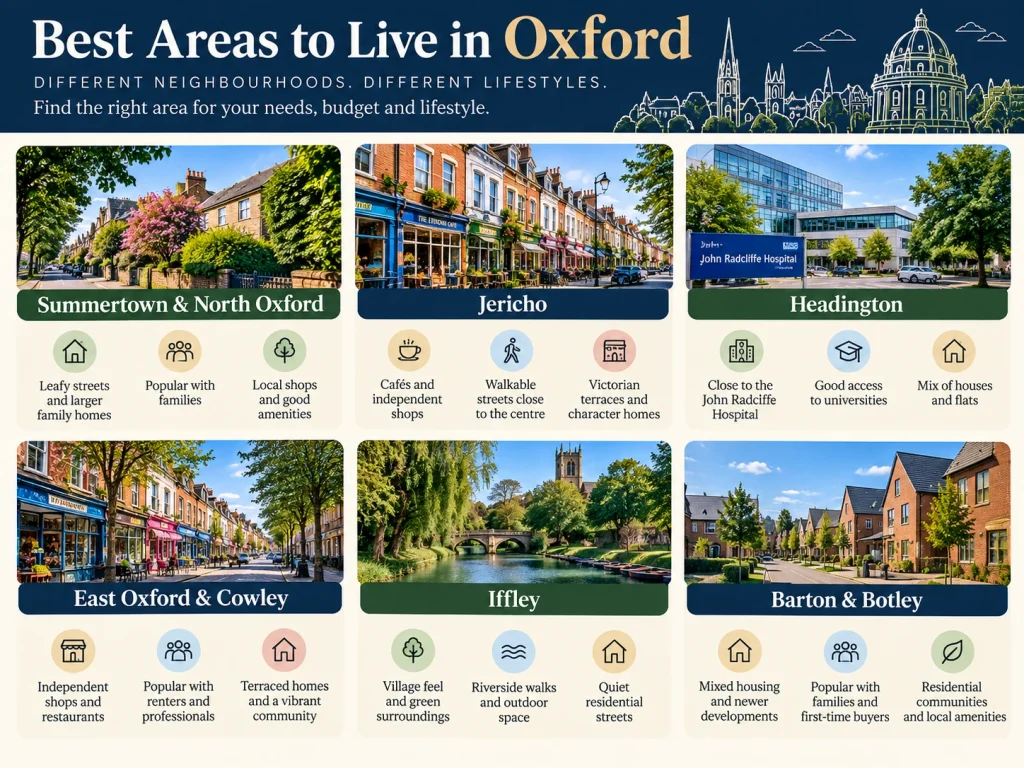
What are the best areas to live in Oxford?
There is no single best neighbourhood for everyone. Families may prioritise schools and outdoor space, while professionals may prefer convenient commuting and access to workplaces. First-time buyers and renters may focus more on property costs.
The following comparison highlights the character of several popular Oxford areas and the practical considerations that can affect a house move.
| Area | Typical housing and character | Who may prefer it | Moving-day considerations |
|---|---|---|---|
| Summertown and North Oxford | Larger detached and semi-detached homes, leafy streets and local shops | Families and buyers seeking more space | Traffic can be busy around schools; check access and parking |
| Jericho | Victorian terraces, independent cafés and canal-side walks | Young professionals and academics | Narrow streets and limited parking may require advance planning |
| City centre and South Oxford | Flats, terraces and period properties close to shops and historic attractions | Students, renters and people wanting a central location | Check loading access, parking restrictions and lift availability |
| Headington | Houses and flats near hospitals and university facilities | Healthcare workers, students and university staff | Check the precise address, parking zones and access arrangements |
| East Oxford and Cowley | Terraced homes, flats, independent shops and restaurants | Renters, professionals and people working nearby | Older streets and local traffic restrictions may affect vehicle access |
| Iffley | Residential streets with a village-like atmosphere and riverside walks | People seeking a quieter setting | Check narrow lanes, parking and the removal vehicle’s approach |
| Barton and Botley | Mixed housing, including newer developments | Families, first-time buyers and people comparing housing options | Access may be easier on some newer estates, but confirm the exact property |
What do homes cost by Oxford postcode?
Postcode averages can help you begin your research, but they should not be treated as exact prices for individual neighbourhoods. Large postcode districts cover different types of properties and locations, and the figures below come from a report whose reporting period was not specified.
| Postcode district | Broad areas covered | Indicative average in the referenced report |
|---|---|---|
| OX1 | Central and South Oxford | About £562,000 |
| OX2 | North and West Oxford, including Summertown and Jericho | About £900,000 |
| OX3 | North East Oxford, including Headington | About £496,000 |
| OX4 | East Oxford, including Cowley and Iffley | About £466,000 |
These are indicative postcode-level figures, not verified current valuations for the neighbourhoods listed. Before making a decision, compare recent sold prices and available properties on the specific streets you are considering.
Is Jericho a good place to live?
Jericho appeals to people who want a walkable neighbourhood with independent shops, cafés, Victorian terraces and convenient access to central Oxford.
However, older streets can be narrow and parking can be limited. If you are moving into a terraced property, tell your removal company about the parking situation, access route and distance from the van to your front door.
Is Headington a good place to live?
Headington is worth considering if you work at the John Radcliffe Hospital, Oxford Brookes University or nearby employment locations. It offers a mix of houses and flats, with amenities and transport connections that vary by street.
Do not assume that every Headington address avoids city-centre traffic restrictions. Check the route from your current home and confirm any relevant parking or permit requirements.
What are the cheaper places near Oxford?
If Oxford’s housing costs exceed your budget, consider comparing nearby towns such as Bicester, Witney and Kidlington.
Older reports have quoted indicative averages of around £364,000 for Bicester, £361,000 for Witney and £419,000 for Kidlington. These figures should not be treated as current market prices without checking the relevant reporting periods.
Also compare commuting costs, train availability, road journeys and parking. A lower property price may not represent the best overall value if daily travel becomes more expensive or time-consuming.
Is Oxford a safe place to live?
Safety varies between neighbourhoods and individual streets. Before committing to a property, research the exact postcode rather than relying on broad city-wide descriptions.
Use the Police.uk crime map to review reported crime in the area. Visit the neighbourhood at different times of day and consider street lighting, walking routes, traffic and parking.
Flood risk is another important consideration. Parts of Oxford are close to the River Thames and other waterways, so check the property’s specific location using the GOV.UK long-term flood-risk service.
If you are moving into a ground-floor flat or house in an area with potential flood exposure, review the property’s flood history and any relevant insurance considerations before making a decision.
How much does it cost to live in Oxford?
The total cost of living in Oxford depends on your housing arrangements, household size, commuting needs and lifestyle. Property prices and council tax are important starting points, but renters and homeowners should also consider transport, utilities, childcare and other regular expenses.
What is the average house price in Oxford?
Rightmove reports an overall average sold price of £558,976 in Oxford over the reported year, using HM Land Registry data. Its figures by property type are:
| Property type | Average sold price |
|---|---|
| Terraced | £537,103 |
| Semi-detached | £554,389 |
| Flat | £345,485 |
The figures represent reported transactions rather than asking prices for properties currently on the market. Other websites may show different averages because of differences in geographical coverage, reporting periods and calculation methods.
Check the latest Oxford sold-price data on Rightmove and compare similar properties before deciding on your budget.
Is council tax high in Oxford?
Oxford’s Band D council tax for 2026/27 is £2,678.40, according to the figures used in this guide.
The government’s published England-wide average Band D figure for 2026/27 is £2,392. Oxford’s figure is therefore around 12% higher than that average. Your actual bill depends on the property’s council tax band and the applicable local charges.
You can review the official figures through the GOV.UK council tax statistics and check the relevant local authority’s guidance before committing to a property.
What does it cost to rent in Oxford?
Rental costs vary according to property size, condition, location and proximity to workplaces, transport links and the city centre.
Rather than relying on one city-wide average, compare current listings for similar properties in your preferred neighbourhoods. Check what is included in the rent, the deposit requirements, tenancy terms and any additional household costs.
If you rent, you can also consult Oxford City Council to check whether the property requires a landlord licence and whether the relevant licensing requirements have been met.
Is Oxford more expensive than London?
Oxford and London have different housing markets, so a direct comparison depends on the areas and property types being considered.
The 2026/27 Band D figures used in this guide are approximately £2,678.40 for Oxford and £2,068 for the London average. However, property prices, rent and transport costs vary significantly across both locations.
| Factor | London | Oxford |
|---|---|---|
| Housing | Wide variation between boroughs and property types | High housing costs, with substantial variation between neighbourhoods |
| Council tax | Average Band D around £2,068 | Band D £2,678.40 |
| Commuting | Extensive Underground, rail and bus networks | Rail, bus, cycling and road travel, depending on location |
| Residential environment | Highly varied urban neighbourhoods | Historic centre, residential suburbs and nearby green spaces |
If you are moving from London to Oxford for more space, compare the total cost of housing, commuting and council tax rather than relying on property prices alone.
How long does it take to get from Oxford to London?
Oxford has rail and coach connections to London, making the city an option for people who need to travel to the capital regularly.
- GWR: The fastest services from Oxford to London Paddington take around 52 minutes. Actual journey times depend on the service and timetable.
- Chiltern Railways: Services connect Oxford and Oxford Parkway with London Marylebone. Check the relevant timetable for your departure station.
- Oxford Tube: This coach service provides connections between Oxford and London, with journey times depending on traffic and the stops served.
- Road travel: The A34, M40 and A40 are important routes for journeys around Oxford and the wider region.
Advance train fares, peak-time prices and journey durations can change. Check the relevant operator’s official booking information for your actual travel date rather than relying on an unverified starting fare.
If you live in North Oxford or nearby areas, Oxford Parkway may be a convenient station to compare with Oxford railway station.
What are the new traffic rules in Oxford?
Oxford’s traffic arrangements changed on 28 September 2026, when a trial of six camera-enforced traffic filters replaced the temporary congestion charge.
The restrictions apply to cars without the required permit during the relevant operating hours. Other vehicle categories, including vans and lorries, are exempt from these filter restrictions under the published scheme. This is particularly relevant when planning a removal involving a van or larger vehicle.
https://www.oxfordshire.gov.uk/transport-and-travel/oxford-traffic-filters?
Where are Oxford’s traffic filters?
The six filter locations are:
- Hollow Way
- Marston Ferry Road
- St Clement’s Street
- St Cross Road
- Hythe Bridge Street
- Thames Street
When do the filters operate?
| Location | Operating days | Operating hours |
|---|---|---|
| Hollow Way | Monday to Saturday | 7am–9am and 3pm–6pm |
| Marston Ferry Road | Monday to Saturday | 7am–9am and 3pm–6pm |
| St Clement’s Street | Monday to Sunday | 7am–7pm |
| St Cross Road | Monday to Sunday | 7am–7pm |
| Hythe Bridge Street | Monday to Sunday | 7am–7pm |
| Thames Street | Monday to Sunday | 7am–7pm |
The restrictions operate throughout the year, including bank holidays. Outside the operating hours, vehicles can pass through without a traffic-filter permit.
Always check the official Oxfordshire County Council traffic-filter information before travelling. The scheme is a trial, so details may change.
What happens if a car passes through without a permit?
The published penalty is £70, reduced to £35 if paid within 21 days. During the first six months of the trial, the council states that the first contravention will receive a warning notice rather than a penalty charge notice.
Check the current permit rules and eligibility requirements directly with the council.
How do traffic filters affect moving day?
If you are driving a car to your new home, check whether your planned route crosses a filter during its operating hours. A permit may be required, depending on your circumstances.
Removal vans and lorries are exempt from the traffic-filter restrictions, but that does not automatically remove parking restrictions, loading rules or other road controls.
Before moving day:
- Confirm the addresses and access arrangements at both properties.
- Check the current traffic-filter map and the planned route.
- Identify any parking restrictions or permit requirements.
- Tell your removal company about narrow streets, loading difficulties or other access concerns.
You can view the official traffic-filter map and permit areas.
Need help planning your Oxford move? Tell Shiftify Removals your moving date and both addresses. We can discuss the access arrangements and plan the removal vehicle’s route as part of your free video survey. Call 08002461969 for assistance.
Is Oxford good for schools and families?
Oxford has a range of state and independent schools, universities, parks and family activities. School suitability depends on your child’s needs, the admissions criteria and the availability of places.
Oxfordshire has no state grammar schools. State-school admissions depend on each school’s published criteria, which may include catchment areas, distance and other priority rules.
Which state secondary schools do families consider?
Families researching Oxford may consider schools such as The Cherwell School and The Swan School, alongside other local secondary schools.
Before choosing a home, check the school’s current admissions policy, catchment information, available places and latest inspection information. Do not assume that living near a school guarantees admission.
Use Oxfordshire County Council’s school admissions guidance and the government’s school performance tables to research your options.
Which independent schools are in Oxford?
Independent schools in Oxford include Magdalen College School, The Dragon School, Headington School, Oxford High School and St Edward’s.
Each school has its own admissions arrangements, fees and entry requirements. Contact the school directly for current information.
If you are moving with children, our guide to moving house with children offers additional advice on keeping routines organised during a relocation.
What is there to do in Oxford?
Oxford has a wide range of cultural attractions, outdoor spaces and shopping destinations.
- Radcliffe Camera and Bodleian Library: Historic landmarks associated with Oxford’s academic heritage.
- Covered Market: A central destination for independent shops and food.
- Ashmolean Museum and Pitt Rivers Museum: Museums with collections covering art, history and anthropology.
- Port Meadow and University Parks: Open spaces for walks and time outdoors.
- Oxford Canal and River Thames: Areas for waterside walks and selected boating activities.
- Cowley Road: Known for independent shops, restaurants and music venues.
- Westgate Oxford: A major city-centre shopping and leisure destination.
Your preferred neighbourhood may depend on how close you want to be to these attractions, your workplace and your usual transport routes.
What are the pros and cons of living in Oxford?
| Pros | Cons |
|---|---|
| Two major universities and a range of educational options | High property prices and rents |
| Major employers, including hospitals and science parks | Council tax above the England-wide average |
| Fast rail connections to London on selected services | Traffic restrictions may affect some car journeys |
| Parks, cycling routes and green spaces | Parking can be difficult on older residential streets |
| Museums, shopping and cultural attractions | Student moving periods can increase demand for removals |
| Access to surrounding countryside | Flood risk should be checked for individual properties |
The best choice depends on your priorities. Compare the cost of housing with your commute, family needs and the practicalities of moving into your chosen street.
Is Oxford better than Reading?
Oxford and Reading offer different advantages. Oxford is known for its historic centre, universities and academic environment. Reading has a larger commercial centre and generally faster direct rail journeys to London Paddington.
| Factor | Oxford | Reading |
|---|---|---|
| General character | Historic university city | Larger commercial town |
| Council tax, Band D 2026/27 | £2,678.40 | Check the latest local figure before comparing |
| Fast rail journey to Paddington | Around 52 minutes on the fastest GWR services | Around 27–30 minutes on selected services |
| Schools | No state grammar schools in Oxfordshire | Reading School and Kendrick School are notable grammar schools |
Journey times depend on the service, and school admission criteria differ. Compare the specific areas and properties that meet your needs.
Read our Moving to Reading: a local guide for more information.
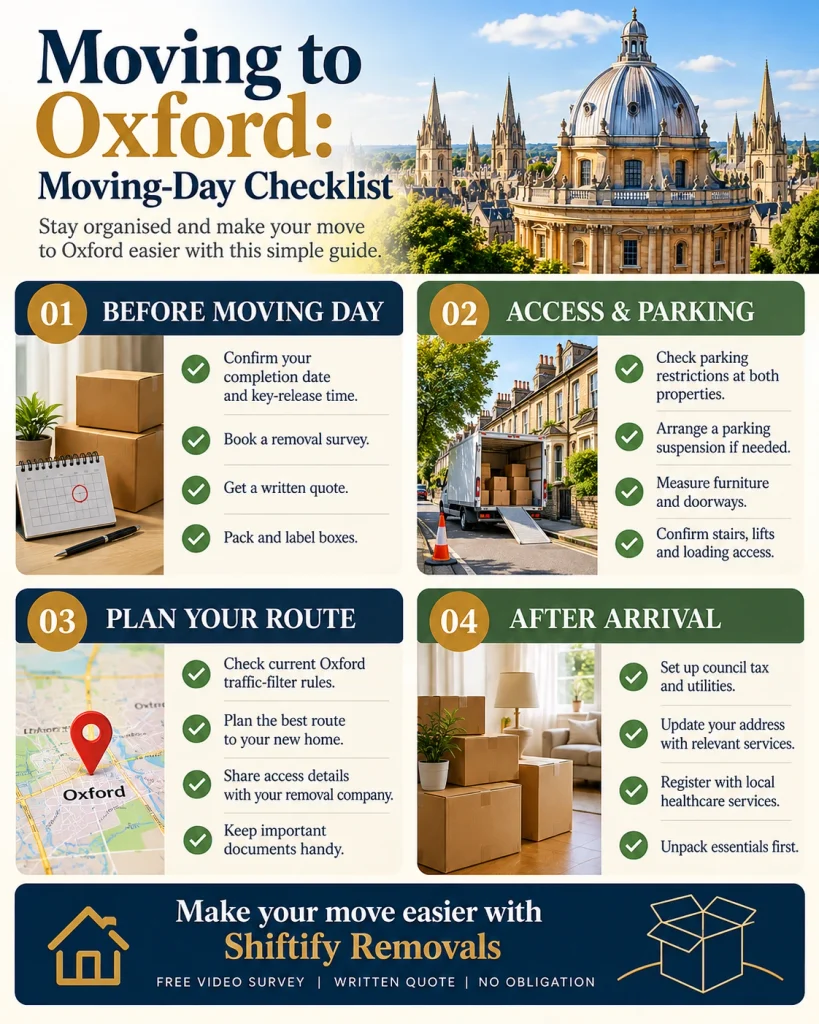
How do you plan a move to Oxford?
A successful relocation starts with an accurate assessment of the property, belongings and access arrangements. Booking a removal survey early helps you understand what is required and receive a written quote based on your move.
Our guide to getting an accurate removal quote explains what to prepare.
What affects the cost of moving to Oxford?
The cost of a removal depends on several factors:
- The volume of belongings and number of rooms.
- The distance between your current home and your new property.
- Stairs, lifts, carry distances and vehicle parking.
- Packing services and furniture dismantling or reassembly.
- Your moving date, particularly weekends and busy month-end periods.
- Any storage required between exchange and completion.
Shiftify Removals offers a free video survey. We review your belongings and access requirements, then provide a written fixed-price quote the same day. There is no obligation to proceed.
We do not quote a single typical price for every move because two properties of the same size may require different crews, time and equipment.
For further information, read our guide to how much removals cost in the UK.
When is the best time to move to Oxford?
Student tenancies often change in late June and September, which can make some moving dates busier than others.
If your completion date is flexible, consider a midweek move and book your survey in advance. If you need to move during a busy period, arrange the removal service early and confirm parking and access details before the day.
Read our guide to the best time to move house in the UK for more planning advice.
What should you check about parking and access in Oxford?
Older residential streets in areas such as Jericho, East Oxford and Cowley may have narrow roads, stairs and restricted parking. Some flats require advance lift bookings, while other properties may have long carry distances from the nearest legal loading point.
Before moving day:
- Check parking restrictions at both addresses.
- Ask Oxfordshire County Council whether a parking suspension is needed.
- Confirm any application requirements and notice periods.
- Measure large furniture and doorways.
- Tell your surveyor about stairs, lifts, narrow entrances and long carry distances.
- Confirm the removal vehicle’s route and any relevant traffic restrictions.
Read the council’s guidance on suspending parking controls and apply early if necessary.
For professional help with your relocation, visit our Oxford house removals service.
What if your keys arrive late on completion day?
Completion delays can disrupt a moving schedule, particularly when the removal vehicle has arrived but the new property is not yet available.
Shiftify Removals can hold your belongings safely in the vehicle until your keys arrive, with no extra waiting charge. If the delay extends beyond the day, we can arrange secure storage and deliver your belongings when completion takes place.
Discuss your completion arrangements with the team in advance so the options are clear.
You can also read our guide to storage during a delayed completion.
Your pre-move checklist
Use this checklist to prepare for moving day.
- Confirm your completion date and expected key-release time with your solicitor or agent.
- Arrange any necessary parking suspension at both addresses.
- Measure large furniture and check doorways at the new home.
- Confirm stairs, lift bookings and carry distances.
- Check the latest traffic-filter rules if anyone will be driving a car through Oxford.
- Tell your removal company about access restrictions and special handling requirements.
- Book your video survey and obtain your price in writing.
What should you do during your first week in Oxford?
Once you have arrived, work through the following tasks:
- Notify Oxford City Council so your council tax account can be set up.
- Register with a local GP and dentist.
- Apply for school places through Oxfordshire County Council if required.
- Check local bus and cycling routes.
- Arrange broadband installation as early as possible.
- Update utility accounts and your address with relevant organisations.
Our broadband and moving house guide, utilities checklist and change of address checklist can help you stay organised.
For a more comprehensive plan, use our complete house moving checklist. Businesses relocating to Oxford can also explore our office removals service.
Moving to Oxford from London: what changes?
Moving from London to Oxford may offer a different pace of life, access to green spaces and a smaller city environment. However, Oxford is not necessarily a cheaper option, particularly when housing and council tax are considered.
Before arranging the move, compare your expected housing costs, commuting requirements and access arrangements at both properties.
Check whether your current London street requires a parking suspension, whether lifts need to be booked and whether the route into Oxford is affected by traffic filters.
Shiftify Removals can help coordinate your move between the two locations. Visit our London removals service for further information.
Frequently asked questions
Is Oxford a good place to live?
Oxford may suit people who value education, employment opportunities, culture and green spaces. Housing costs are high, so compare property prices, council tax and commuting expenses before deciding.
What are the best areas to live in Oxford?
Summertown and North Oxford appeal to many families, while Jericho attracts people seeking a walkable neighbourhood near the centre. Headington suits some hospital and university workers, while East Oxford, Cowley, Barton and Botley offer different housing options.
Is Oxford safe?
Safety varies by street. Check the relevant postcode on Police.uk and visit the neighbourhood at different times before committing to a property.
How long does it take to travel from Oxford to London?
The fastest GWR services to London Paddington take around 52 minutes. Journey times vary by service, and Chiltern Railways also provides services to London Marylebone.
Is Oxford more expensive than London?
Costs depend on the locations and properties compared. Oxford’s Band D council tax is £2,678.40 for 2026/27, compared with the London average of around £2,068.
What is the average house price in Oxford?
Rightmove reports an average sold price of £558,976 over its reported year. Prices vary by property type and location, so check current sold-price data for your preferred area.
Is council tax high in Oxford?
Oxford’s Band D council tax is £2,678.40 for 2026/27, above the published England-wide average. Your actual bill depends on the property’s council tax band and applicable charges.
Does Oxford have grammar schools?
Oxfordshire has no state grammar schools. State-school admissions depend on the school’s published criteria, which may include catchment, distance and other priorities.
What are the new traffic filters in Oxford?
Six camera-enforced traffic filters began a trial on 28 September 2026. Cars without the required permit are restricted during operating hours. Check the official council guidance for current rules.
What are the cheaper places near Oxford?
Bicester, Witney and Kidlington may offer lower property prices than Oxford, depending on the property and reporting period. Compare current listings, commuting expenses and transport options.
How much does it cost to move to Oxford?
Removal costs depend on the volume of belongings, distance, packing requirements, access and moving date. Shiftify Removals provides a free video survey and a written fixed-price quote with no obligation.
Ready to make the move?
Oxford offers a distinctive mix of historic surroundings, universities, employment opportunities and access to green spaces. Choosing the right area and planning your move carefully can help make the transition easier.
Shiftify Removals is based in Aylesbury and serves customers across Buckinghamshire, Oxfordshire and Berkshire. Our team brings 10 years of experience and more than 20,000 completed moves.
Our free video survey takes around 15 minutes. We assess your belongings and access requirements, then provide a written fixed-price quote the same day, with no obligation to book.
If completion is delayed, we can hold your belongings safely in the vehicle without an extra waiting charge, or arrange secure storage if the delay extends beyond the day.
Book your free video survey with Shiftify Removals or call 08002461969 to discuss your move to Oxford.