

When you move house in the UK, you usually do not need to install gas, electricity or water from scratch. The supply is already connected. What you actually need to do is tell your old suppliers you are leaving, record your meter readings, take over responsibility for the new home’s utilities, and then decide whether to switch to a better energy deal. That is the whole job in one sentence.
Whether you are a first time buyer or renting, and whether you are moving across Aylesbury or into Buckinghamshire from further away, you will know exactly what to do before you move, on moving day, and in your first week. We move families around Aylesbury every week, so this is the same practical advice we give our own customers.
How do you sort utilities when you move?
Tell your current gas and electricity suppliers you are leaving, giving as much notice as you can, read every meter on moving day, and give your old suppliers a forwarding address for the final bill. At the new home, find out who supplies the gas and electric, contact them with the date you moved in and your opening readings, and take over the account. Tell the local water company, book broadband early, and update your council tax and TV Licence. Once the property is yours, you can compare energy tariffs and switch to save.
At a glance
- Tell your old suppliers you are leaving
- Read the gas, electric and water meters on moving day
- Find out who supplies your new home
- Take over the account with your move in readings
- Tell the local water company
- Book broadband early
- Compare and switch energy once you are settled
Moving house utilities checklist
Here is the whole job as a checklist, split into three easy stages.
Before moving day
- [ ] Tell your current gas and electricity supplier you are moving
- [ ] Check your tariff for any exit fee if you are on a fixed deal
- [ ] Arrange your broadband for the new home
- [ ] Find out who supplies the new home’s gas and electric
- [ ] Note where the meters are at both homes
On moving day
- [ ] Photograph the old gas, electric and water meters
- [ ] Photograph the new meters as soon as you arrive
- [ ] Record the date and time
- [ ] Send final readings to your old suppliers
- [ ] Check whether the new home has a prepayment meter
- [ ] Keep all your evidence in one place
In your first week
- [ ] Open your energy account with the new home’s supplier
- [ ] Register with your local water company
- [ ] Update your council tax and TV Licence
- [ ] Compare energy tariffs and switch if it saves you money
- [ ] Confirm your broadband is active
How gas and electricity work when you move in
This is the part that confuses most first time buyers, so here it is simply. Your new home already has a gas and electricity supply, and there is already a supplier attached to the property. You are not choosing or installing anything on day one. You are taking over the existing account.
On the day you move in, read the meters, then contact the supplier that already serves the property, give them your readings and the date, and open your account in your name. You automatically enter what is called a deemed contract with that supplier, normally on their default or standard variable tariff. It keeps your gas and electric on straight away. It may not be the best value option for you, so it is worth comparing tariffs once your account is set up, but there is no rush on your first night.
How do you transfer utilities when moving to a new home?
Transferring utilities really means two things: closing your accounts at the old home and taking over the accounts at the new one. To do it, give your current suppliers notice that you are leaving, read your meters on the day you go, and give them a forwarding address so they can send your final bill. At the new home, find out who supplies the gas and electric, contact them with your move in date and opening readings, and set up your account. Tell the local water company you have arrived, book your broadband early, and update your council tax and TV Licence. Once the property is legally yours, you can compare and switch energy suppliers if you want a cheaper deal.
How to find your new energy supplier
Often the seller, your landlord or your solicitor will tell you who supplies the gas and electric. If not, it is easy to find out. To find your electricity supplier, use the free Find My Supplier service, which looks up the supplier and your meter number by postcode. To find your gas supplier, there is a Meter Number Helpline you can call. Citizens Advice also has a clear guide to help you find out who your energy supplier is. Once you know who supplies the property, you have everything you need to open your account.
Compare gas and electric, and switch to save
You do not have to stay on the deemed contract you are placed on when you move in. Once the property is yours, you are free to compare gas and electric prices and move to a better deal. You can switch to a different tariff with the same supplier or switch to a new supplier entirely. Keep in mind you will usually pay at least one bill with the existing supplier before a switch to a new company completes, and a switch normally takes around five working days. If anyone in your home is over State Pension age, disabled or has a long term illness, ask the supplier to add you to their Priority Services Register for extra help.
Do I need to set up gas and electricity before I move in?
You do not need to install or reconnect anything, because the supply is already there. What matters is that you take over the account from the right day, so you are not billed for the previous occupant’s usage. You take over responsibility from the day the property becomes yours, which is completion day if you are buying, or the start date on your tenancy agreement if you are renting. So while you cannot fully set up gas and electric for a new home weeks in advance, you can contact suppliers ahead of time to line everything up, and the account then starts from your move in date. In short, can you set up utilities before moving in? You can prepare, but the account itself begins the day you become responsible for the home.
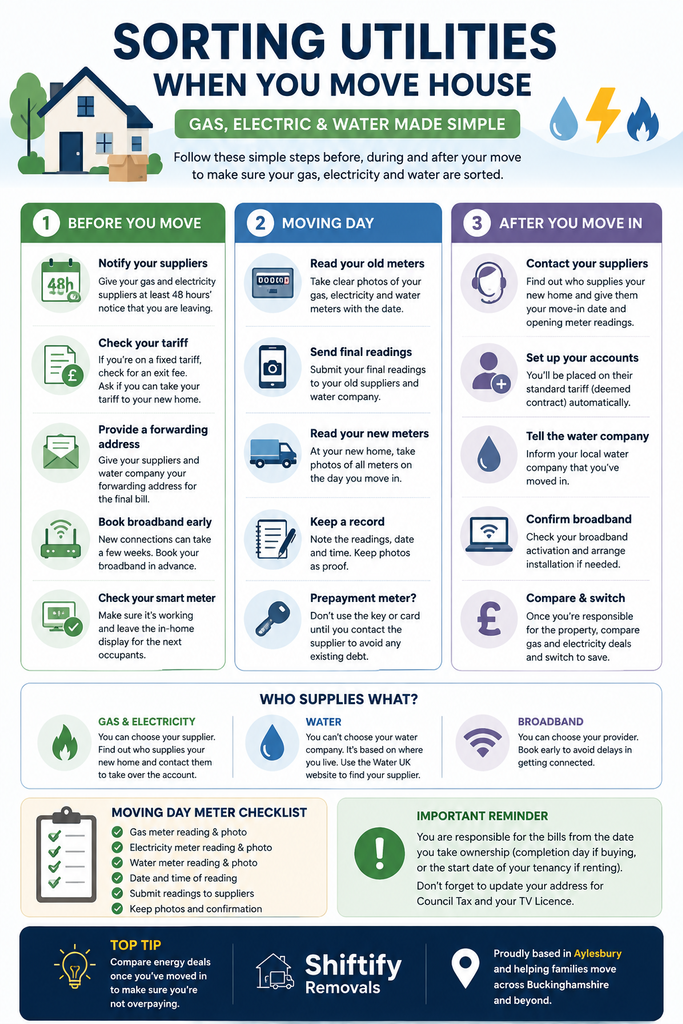
Moving with a prepayment meter
Some homes have a prepayment meter, where you top up before you use any gas or electricity. If yours does, there is one important rule. Do not inherit the previous occupant’s debt. Contact the supplier before you top up or use the key or card, because old debt left on the meter can otherwise become your problem. Ask them to remove any debt from the meter, send you a fresh key or card, and explain how it works. You can usually ask to swap a prepayment meter for a standard smart meter later, which is often cheaper to run.
What to photograph on moving day
Photographs are your proof if a bill is ever wrong, so take them at both homes. On your phone, capture the electricity meter reading and its serial number, the gas meter reading and serial number, and the water meter reading if there is one. Snap the condition of each meter or display too, and make sure the date and time are on your phone. These few photos take a minute and can save you a long dispute later.
What if the meter reading does not match?
Now and then a reading does not line up with what a supplier expects, often because the previous occupant gave an estimate rather than an actual reading. If that happens, do not worry. Photograph the meter straight away, record the date, and submit your reading to the supplier. If the previous reading looks clearly wrong, contact the supplier and send them your photo. Keep your completion or tenancy paperwork too, as it proves the date you became responsible for the property.
How to sort water when moving house
Water works differently from energy. With gas and electric you can choose and switch supplier, but with water you cannot, because your supplier is set by where you live. All you need to do is tell the water company for your new area that you have moved in, and give a meter reading if the home has a water meter. If it does not, your bill is based on the property’s rateable value instead. If you are not sure who your water company is, enter your postcode in the Water UK find your supplier tool. If you are moving around Aylesbury, check your exact postcode there rather than assuming which company covers the property, as it can vary from street to street.
If you are renting
Renters need to do a few extra checks. Read your tenancy agreement to confirm which bills are yours and which, if any, are included in the rent. Take meter readings at check in and note the date, so your usage starts from the right point. If bills are not included, contact the suppliers yourself to set up your accounts, and check whether your landlord or agent has specified a particular supplier. Do not assume the previous tenant’s account simply passes to you, because it does not.
Broadband and the easy ones to forget
Broadband is the utility people leave too late. Sort it as soon as your move is confirmed. Check whether your current deal can move with you, confirm the activation date, and find out whether an engineer visit is needed, as these can take a few weeks to book. If you work from home, do not cancel your old broadband too early, so you keep some overlap. While you are at it, remember your council tax and TV Licence both need updating. Our change of address checklist covers those and everyone else you need to tell when you move.
Who to contact, and when
| Utility | When to sort it | What to do |
|---|---|---|
| Gas and electric (old home) | Before you move | Give notice, read meters, leave a forwarding address |
| Gas and electric (new home) | On or just after move in | Find the supplier, give opening readings, take over the account |
| Water | Around your move in date | Tell the local water company, give a meter reading |
| Broadband and phone | As early as possible | Book the connection or engineer visit |
| Council tax and TV Licence | Around your move | Update your address |
Moving in and around Aylesbury
If you are moving within Aylesbury or to a nearby town like Wendover, Thame, Buckingham, Oxford or Milton Keynes, the steps are the same, with a couple of local pointers. Your water company is set by your postcode, so use the Water UK finder to see exactly who covers your address. Council tax and the electoral roll are handled by Buckinghamshire Council. And because Aylesbury is a busy commuter town, broadband slots and engineer visits can fill up, so booking your internet early really pays off. Planning the rest of your move as well? Our house moving checklist lays out the full timeline, and our moving day survival guide walks you through meter readings and the day itself.
The bottom line
Sorting utilities when you move sounds daunting, but it is really a short routine. Tell your old suppliers you are leaving, photograph every meter on moving day, take over the accounts at your new home, and tell the local water company. Book broadband early, update your council tax and TV Licence, and once you are settled, compare gas and electric and switch to a deal that suits you. Do that, and your new home will be warm, lit and connected from the moment you arrive.
Why choose Shiftify Removals
Shiftify Removals are a removals company based in Aylesbury, and while you sort the paperwork and the utilities, we take care of the heavy lifting so your move stays calm from the first box to the last.
Every move comes with a clear price agreed up front, so you always know what to expect. You can read more about us . Alongside house removals, we also offer packing, furniture assembly, storage and long distance moves. If you have a move coming up, keeping costs down matters too, so take a look at our moving on a budget guide.
Ready to go? You can get a free, no obligation quote today and get honest help from a team that knows Aylesbury well.
Utilities and moving FAQs
Do I need to set up gas and electricity before I move in?
No, the supply is already connected. Contact the existing supplier on or just after your move in day so the account is in your name from the start, which stops you paying for the previous occupant’s usage.
Can you set up utilities before moving in?
You can contact suppliers in advance to line everything up, but your account starts from the day you become responsible for the home, which is completion day if buying or the tenancy start date if renting.
How do I find out who supplies my new home’s electricity and gas?
Use the free Find My Supplier service to find your electricity supplier by postcode, and the Meter Number Helpline for gas. Your solicitor, landlord or the seller may also tell you.
How much notice do I need to give my energy supplier?
Citizens Advice recommends giving your current supplier at least 48 hours’ notice, along with your moving date and a forwarding address for the final bill.
Do I have to pay for the previous occupant’s energy?
No, as long as you take a meter reading on the day you move in and give it to the supplier straight away, so only your usage is billed.
What is a deemed contract?
It is the contract you automatically enter with the existing supplier when you move in, normally on their default or standard variable tariff. It keeps your energy on, but it may not be the best value, so compare tariffs once you are set up.
When will I get my final bill and any refund?
Under Ofgem’s standards, your supplier should send your final bill within six weeks, and refund any credit on your account, usually within ten working days.
How do I sort water at my new home?
Tell the water company for your area that you have moved in and give a meter reading if there is a water meter. You cannot switch water company, as it is set by your location. Use the Water UK postcode tool if you are unsure who supplies you.