Reading is a good choice if you want a big Berkshire town with fast trains to London, a strong job market and lower house prices than the capital. The trade offs are council tax above the national average, busy roads around the town centre and big differences between one area and the next.
We move families and businesses across Berkshire and Buckinghamshire every week. The problem most people tell us about is the same: Reading is a big town, online opinions clash, and it is hard to tell which area, school route or budget really fits. The solution is to compare checked facts side by side, such as prices, council tax, train times and school tests, then visit your shortlist before you commit. We name our sources so you can check every figure.
Get a free quote for your move to Reading. Video survey, written price, no obligation
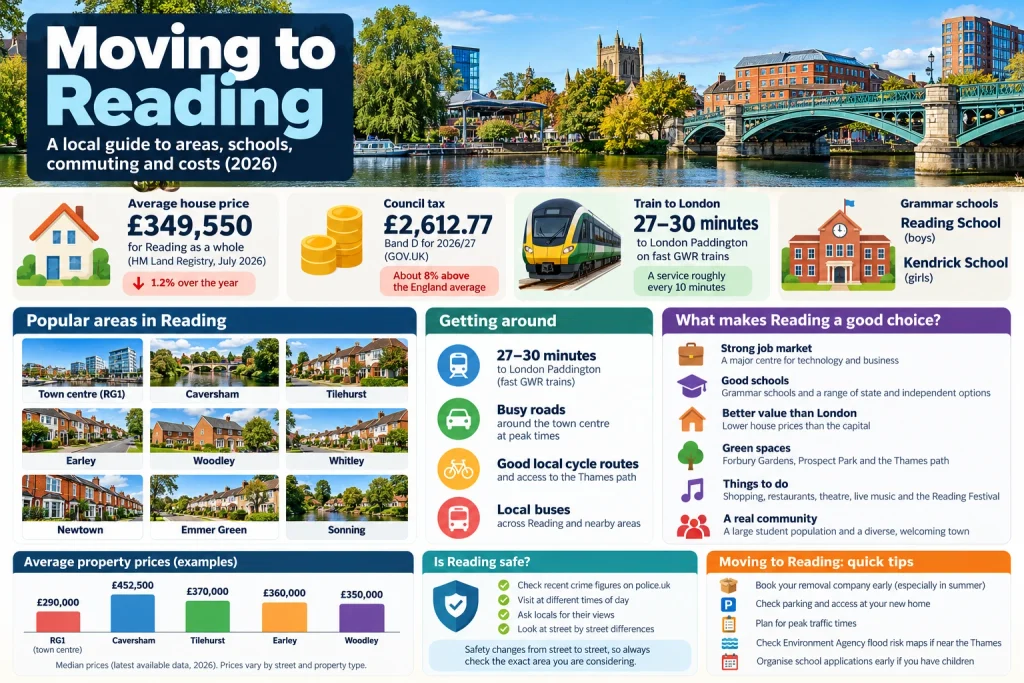
Is Reading a good place to live? The quick facts
| Topic | What the data says |
|---|---|
| Average house price | £349,550 for Reading as a whole, down 1.2% over the year (HM Land Registry, July 2026) |
| Town centre prices (RG1) | Median £290,000 and mean £316,855 from 51 sales, June to August 2026 |
| Council tax | Band D is £2,612.77 for 2026/27, about 8% above the England average of £2,411 (GOV.UK) |
| Train to London Paddington | About 27 to 30 minutes on fast GWR trains, with frequent services through the day |
| Grammar schools | Reading School (boys) and Kendrick School (girls) |
| University | University of Reading, with a large student population |
What is it like to live in Reading?
Reading is the largest town in Berkshire. It sits where the River Kennet meets the Thames, and it mixes old landmarks with a busy business centre. You will find the Abbey ruins, Forbury Gardens and the Oracle shopping centre close together in the middle of town. Around that core, suburbs spread out in every direction.
Reading is a major centre for technology and business in the Thames Valley. Many people who live here also work here, which is different from commuter towns where most residents leave each morning.
Online views are mixed, and that is useful to know. On Reddit, one long term resident called the town “perfectly fine” and “very functional.” On Quora, people ask whether it is boring. Some Facebook comments are harsh, and others come from residents who say they have lived here for years and do not regret it. The honest summary: Reading suits people who want jobs, transport and choice more than a picture postcard feel.
Is Reading boring?
Not if you like variety. The town has the Oracle and Broad Street for shopping, Reading Museum, live music, a large student scene and the Reading Festival every August bank holiday weekend. Green space is close by, including Forbury Gardens, Prospect Park and the Thames path through Caversham.
If you want a lively London style nightlife, you will find Reading quieter. If you want everyday choice, with many restaurants, a big theatre and music scene and fast trains, you will find plenty.
What are the best areas to live in Reading?
There is no single best area. The right choice depends on your budget, commute and schools. Here is a plain guide to the areas people ask about most.
| Area | Typical homes | Character | Often suits |
|---|---|---|---|
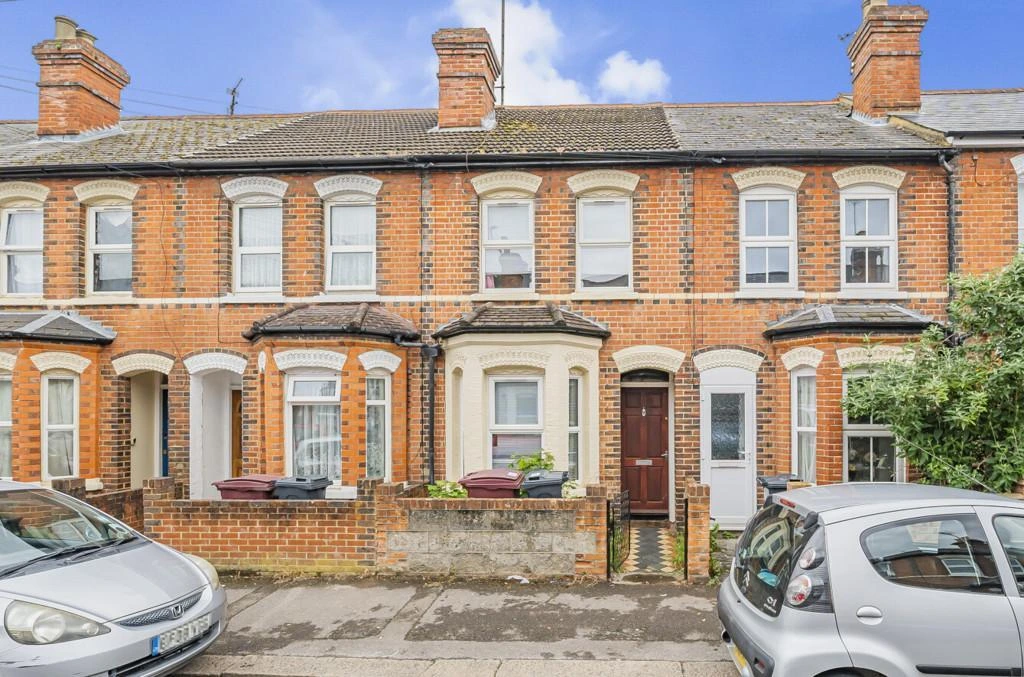
| Town centre (RG1) | Flats and terraces | Close to Reading station, the Oracle and Forbury Gardens | Young professionals, commuters, renters |
| Caversham | Mix of terraces, semis and larger homes | North of the Thames with independent shops and riverside walks. Popular with commuters | Commuters and families |
| Tilehurst | Family houses, many semis | Residential suburb in west Reading with its own station | Families, first time buyers |
| Earley and Lower Earley | Mostly 20th century houses | Suburban area with well regarded schools, including Maiden Erlegh | Families |
| Woodley | Post war and modern houses | Largest suburb, with its own shops and supermarkets | Families on a mid range budget |
| Whitley | Mixed houses and flats | South of the centre, near Reading Football Club’s stadium | Budget buyers and renters |
| Newtown and East Reading | Victorian terraces and flats | Close to the University and the town centre. Local residents report a large South Asian community | Students, young families, renters |
| Emmer Green | Family houses | Leafy north Reading suburb near Highdown School | Families |
| Sonning | Period homes and cottages | Thames village outside town with higher prices | Higher budgets |
Which areas are closest to the station and the University?
Town centre flats and the streets near Caversham Bridge are the closest to Reading station. Newtown, Earley and Whitley are the nearest residential areas to the University of Reading’s Whiteknights campus. Convenience is not a promise of journey times, so test the route at the hours you will travel.
Is Caversham nice to live in?
Many commuters like it. It is across the river from the centre, has independent cafes and shops, and is within walking distance of Reading station for people who live close to the bridge. One sold price website (Locara) lists a median price of about £452,500 in Caversham, but it does not state the exact period, so treat it as a rough guide. It is well above the town average. Prices vary a lot by street, so check recent sales for your own street.
Which areas of Reading should you avoid?
Reddit and Facebook users often ask this, and the answers vary. Some residents say parts of the town are rough, and others say they have lived in the same area for years with no problems. Do not rely on one comment. Use the official crime map at police.uk for the exact postcode you are considering, then visit at different times of day.
Is Reading a safe place to live?
Safety changes from street to street, not just from area to area. Your checks should be:
- Look at recent crime figures on police.uk for your postcode.
- Visit on a weekday morning, at school pickup and on a weekend evening.
- Ask neighbours about parking, noise and anti social behaviour.
- Look at lighting on the walk to the station.
How much does it cost to live in Reading?
What is the average house price in Reading?
HM Land Registry data puts the average Reading house price at £349,550 for July 2026, a fall of 1.2% over twelve months. That is an area wide average that mixes flats and houses.
Prices vary by postcode. In the RG1 town centre area, the median sale price was £290,000 from June to August 2026. Median prices by type in that sample were:
| Property type (RG1) | Median price |
|---|---|
| Flat or maisonette | £237,500 |
| Terraced | £304,000 |
Those figures come from only 51 sales, so treat them as a guide. Different websites use different dates and methods. Look at recent sold prices on your exact street.
Nationally, house prices are flat. Which? reports little change across the UK in 2026, and Rightmove and Savills forecast about 2% growth.
Is council tax high in Reading?
Yes, compared with the national average. Reading’s Band D charge is £2,612.77 for 2026/27, about 8.4% above the England average of £2,411. That is higher than Maidenhead, where Band D is £1,952.62.
If you will live in a smaller home, your bill is lower. A Band A property pays two thirds of the Band D charge, which works out at about £145 a month on the Band D figure above. Check your property’s band on GOV.UK before you commit.
What does it cost to rent in Reading?
Rents change often and depend on size, area and how close you are to the station or the University of Reading. Check live listings for the areas you like, and compare the same property type in each area. We do not quote a typical rent here because published figures differ by source and month.
Is Reading cheaper than London?
For buying, yes. Using the same HM Land Registry index for July 2026, the average Reading price is £349,550, against about £550,000 for London as a whole. For council tax, no. London’s average Band D is about £2,068, which is lower than Reading’s £2,612.77.
| Topic | London | Reading |
|---|---|---|
| Average house price (July 2026) | About £550,000 | £349,550 |
| Average Band D council tax 2026/27 | About £2,068 | £2,612.77 |
| Journey to central London | Underground, bus or rail | About 30 minutes by fast train to Paddington |
| Space | Flats and smaller homes are common | More houses and gardens in the suburbs |
Redditors ask whether it is worth living in Reading while working in London. The honest answer depends on your hours. A daily season ticket adds cost and about an hour of travel each day, so many people mix office days with home working.
How long does it take to get from Reading to London?
Reading is one of the best connected towns in the South East.
- GWR fast trains to London Paddington take about 27 to 30 minutes, with several trains an hour. Check the GWR timetable for the service pattern at your travel time.
- The Elizabeth line also runs from Reading and carries on through central London without a change, but it takes longer to Paddington. Journey times vary by service, so check the timetable.
- Roads: The M4 runs along the south side of town, with junctions 10, 11 and 12 close by.
Tilehurst and Earley have their own stations, which helps if you live outside the centre. Caversham residents walk or cycle across the river to Reading station.
Test your own journey at rush hour before you decide.
Is Reading a good place for jobs?
Yes. The town is a base for technology and business firms across the Thames Valley. Many people live and work locally, and others commute to Slough, Maidenhead or London. The University of Reading and the Royal Berkshire Hospital are also large employers.
If you are moving for work, look at the commute from each area to your workplace, not only to the station.
Is Reading good for schools and families?
Schools are a big reason families come here, and the system is simple once you know the steps.
Which grammar schools are in Reading?
- Reading School is a boys’ grammar school.
- Kendrick School is a girls’ grammar school.
Each school runs its own entrance test and registration, and the arrangements differ. Reading School uses its own exam, while Kendrick uses multiple choice papers. Children usually sit the tests in Year 6, and registration opens earlier in the year. For the 2026 entry round, the dates published by guides based on each school’s information were:
| School | Registration | Test date |
|---|---|---|
| Reading School | 25 March to 17 May 2026 | Main tests in July, plus 25 September 2026 for some day applicants |
| Kendrick School | 1 May to 1 July 2026 | 19 September 2026 |
Results come in mid October, you apply through the council’s common application form by 31 October, and offers come out on 1 March. Dates, rules and catchment details change each year, so read each school’s own admissions page, and Reading Borough Council’s school admissions page, before you plan.
What are the main non selective schools?
Families often look at Maiden Erlegh School in Earley, Highdown School in Emmer Green, Bulmershe School in Woodley, Reading Girls’ School, King’s Academy Prospect in Tilehurst and John Madejski Academy. Places depend on distance from home and the school’s published rules. Apply through Reading Borough Council, where you list your school preferences. Check the council’s current rules for how many you can name.
What about independent schools?
Local options include Leighton Park, The Abbey and Queen Anne’s School in Caversham. Each runs its own assessments.
Use the government’s school performance tables and the latest Ofsted reports to compare schools. Read the newest report, because Ofsted changed how it reports in September 2024.
If you are moving with children, read our guide to moving house with children.
What is there to do in Reading?
- Reading Abbey ruins show the town’s medieval past. Reading Abbey was founded in 1121.
- Forbury Gardens is the central park, next to the Abbey ruins.
- The Oracle and Broad Street cover most shopping needs.
- Reading Museum is in the Town Hall on Blagrave Street and shows local history.
- The Blade is the best known tower in the skyline.
- Prospect Park and Caversham Court Gardens are popular for walks.
- The River Thames and the Kennet and Avon Canal offer towpath walks and boat trips.
- Reading Festival takes place every August bank holiday weekend.
Reading is also known for Huntley and Palmers biscuits, which were made in the town for over a century.
What are the pros and cons of living in Reading?
| Pros | Cons |
|---|---|
| Fast trains to London Paddington | Council tax is above the England average |
| Strong local job market | Traffic is heavy around the town centre |
| Lower house prices than London | Opinions on some areas are mixed, so research each street |
| Two grammar schools and several non selective options | Grammar places depend on test scores |
| Thames, parks and countryside nearby | Student areas can be busy and noisy |
| Large choice of shops, food and events | Town centre flats may have limited parking |
Is Reading better than Maidenhead?
They suit different people. Use this table, then check sold prices and train times for your own needs.
| Topic | Reading | Maidenhead |
|---|---|---|
| Size | Larger town with more jobs and shops | Smaller, quieter, riverside |
| Average house price | £349,550 (July 2026) | SL6 mean about £548,000 (June to August 2026) |
| Band D council tax 2026/27 | £2,612.77 | £1,952.62 |
| Fast train to Paddington | About 27 to 30 minutes | About 25 minutes (see our Maidenhead guide for sources) |
Read our Moving to Maidenhead guide for the full picture. The two prices use different methods, so compare sold prices for each street.
How do you plan a move to Reading?
A good move starts with a fixed price based on a proper survey. Our guide on how to get an accurate removal quote shows what to prepare.
What affects the cost of moving to Reading?
- The volume of belongings and the number of rooms
- The distance between the two homes
- Stairs, lifts and how far the van must park from the door
- Whether you want packing, or dismantling and rebuilding of furniture
- Your moving date, since weekends and month ends are busier
- Any storage you need between exchange and completion
We give a fixed written price after a video survey. We do not guess a typical price, because two houses of the same size can need very different crews. For general ranges, read our guide on how much removals cost in the UK.
What should you check about parking and access in Reading?
Reading has a one way Inner Distribution Road (IDR) around the town centre. Plan van routes in and out so the crew does not lose time, and avoid the centre at rush hour if you can.
Streets near the centre, such as in Newtown, Katesgrove and parts of Caversham, have older terraced homes with narrow roads and steep stairs. Many residential streets have parking permits. Ask Reading Borough Council early whether you need a parking suspension for the van, because rules and notice periods differ by street.
Estates such as Lower Earley and Woodley usually have wider roads and easier loading. Town centre flats may need a lift booking, and that affects the day plan. Tell your surveyor about both properties.
Some low lying parts of Reading and Caversham sit near the Thames and the Kennet. Check the flood risk for your new address on the GOV.UK flood risk service before you buy or rent.
You can read more about our Reading house removals service.
Planning a move to Reading? Tell us your moving date, property size and access needs, and get a free video survey and a written quote from Shiftify Removals. Call 08002461969.
What if your keys arrive late on completion day?
Completion delays are common. Shiftify holds your belongings safely in the vehicle until your keys arrive, with no extra waiting charge. If the delay runs past the day, we can move your things into secure storage and deliver when you complete. Read our guide to storage during a delayed completion.
What should you do in your first week? A Reading moving checklist
- Tell Reading Borough Council you have moved so council tax is set up.
- Register with a local GP and dentist.
- Apply for school places if you have children.
- Book broadband early. See our broadb and and moving house guide.
- Work through our utilities checklist and change of address checklist.
For the full plan, use our complete house moving checklist. If you are relocating a business, see our office removals service.
Moving to Reading from London: what changes?
If you move from London to Reading, you will usually pay much less to buy, have more space and keep a fast rail link. Council tax goes up, because Reading’s Band D is above the London average. Your journey to central London is longer than from many inner London areas, but it is quick for a town this size.
Check these before you move:
- Whether your London street needs a parking bay suspension for the van.
- Lift booking and carry distances at both homes.
- Which train services fit your working hours.
See our London removals service for help with both ends of the move.
Ready to make the move?
Reading offers jobs, fast trains and lower prices than London. A good plan makes the move smoother: pick your area, check your costs and book a survey early.
As South East movers based in Aylesbury, we know the roads across Berkshire and Buckinghamshire. Our video survey takes about 15 minutes and gives you a written price with no obligation.
Book your free video survey with Shiftify Removals
FAQs
Is Reading a nice place to live?
Many people find it a good fit because of the jobs, the fast trains to London and the choice of areas. Opinions online are mixed, so visit your chosen area at different times of day.
What are the best areas to live in Reading?
Families often look at Earley, Woodley, Tilehurst and Emmer Green. Commuters often choose Caversham or the town centre. Sonning suits higher budgets.
Which areas of Reading should I avoid?
There is no official list, and online opinions vary. Check the exact postcode on police.uk and visit at different times of day before you decide.
Is Reading safe?
Safety varies by street. Use the police.uk crime map for your postcode and talk to neighbours.
Is Reading cheaper than London?
For buying, yes. The average price is £349,550 in Reading, against about £550,000 across London. Council tax is higher in Reading.
How far is Reading from London?
Fast GWR trains reach London Paddington in about 27 to 30 minutes.
What is the average house price in Reading?
£349,550 across the borough in July 2026. Prices vary widely by area, with Caversham and Sonning higher.
Is council tax high in Reading?
Band D is £2,612.77 for 2026/27, about 8.4% above the England average of £2,411.
Does Reading have grammar schools?
Yes. Reading School is for boys and Kendrick School is for girls. Each runs its own entrance test, and offers are made on 1 March. Check each school’s admissions page for current rules.
Is Reading a diverse place to live?
Local residents report large South Asian communities in East Reading and Newtown, with community centres and local groups. Visit the area and speak to local residents before you decide.
How much does it cost to move to Reading?
It depends on the size of your home, the distance, packing needs and access. We give a fixed written price after a free video survey.