

You’ve done the hard part. The boxes are packed, the date is booked, and the removals team is on its way. Now it’s moving day, the day it all becomes real.
Moving day can feel noisy, rushed, and a little chaotic. But it doesn’t have to be stressful. With a clear plan, you can stay calm, keep things moving, and settle into your new home feeling in control.
This is your hour-by-hour survival guide, written by a team that does this every day.
Table of Contents
what should I do on moving day?
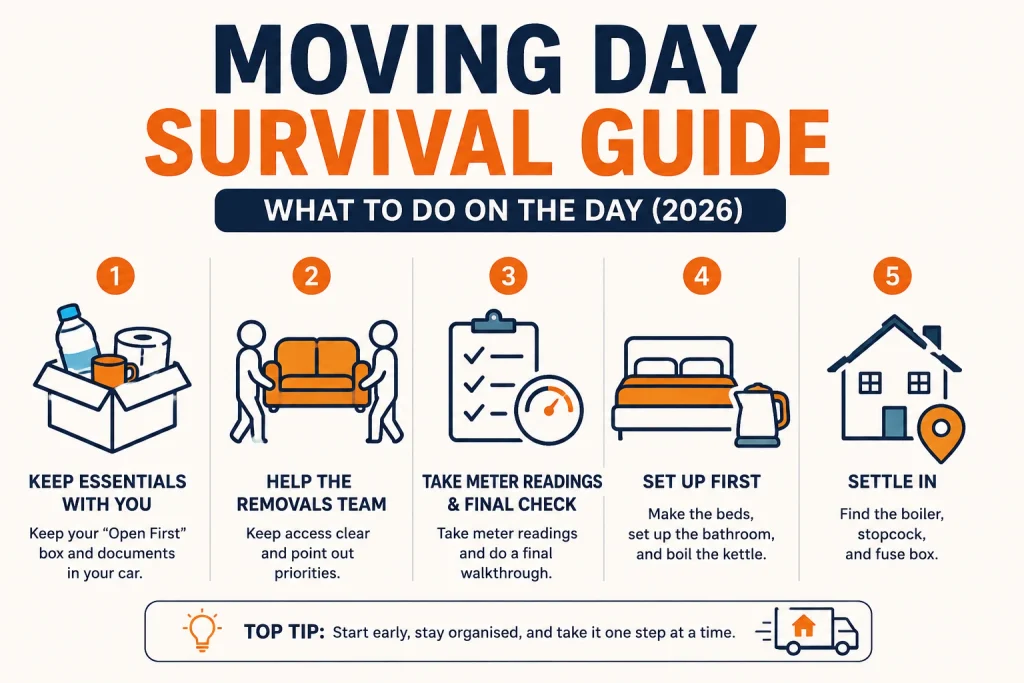
On moving day, focus on four things:
- Keep your essentials and documents with you, not in the van.
- Help the removals team by keeping access clear and pointing out priorities.
- Take meter readings and do a careful final walkthrough before you leave.
- Set up beds, bathroom, and the kettle first at your new home.
At a glance
- Get up and dressed early, around 7-8am
- Keep your “Open First” box and documents in your car
- Take meter readings at both homes
- Check every room, cupboard, loft, shed, and the garden before leaving
- Lock up and hand over keys as agreed
- Set up beds and the kettle first
- Find the boiler, stopcock, and fuse box
Your moving day survival kit
Pack a box or bag of things you’ll want before you unpack everything. Label it clearly as “Open First” and keep it with you in your car, not in the van. Prepare it a day or two ahead.
| Category | What to include |
|---|---|
| Drinks & snacks | Kettle, mugs, tea/coffee, bottled water, snacks |
| Bathroom | Toilet roll, toiletries, hand soap, towels |
| First night | Bedding, pillows, pyjamas, a change of clothes |
| Health | Medication, first aid kit |
| Tech | Phone chargers, power bank |
| Tools | Screwdriver, scissors, box cutter, tape, torch |
| Cleaning | Cloths, spray, bin bags |
Have kids or pets? Add their snacks, toys, food, and comfort items too.
Moving day documents to keep on you
Keep these together in a folder that travels with you, never in the van:
- Property and completion details
- Solicitor’s contact details
- Estate agent’s contact details
- Your removals company’s details
- Inventory or packing list
- Parking and access information
- Insurance details
- Keys
- ID
- Meter-reading records
The night before
A calm moving day starts the night before. Walk through your home as if you’re arriving with the crew in the morning, and finish any last packing, no half-filled boxes or loose piles, which slow the crew down.
Put these aside overnight so they don’t get packed by mistake:
- Clothes for moving day
- Breakfast and kettle/coffee supplies
- Medication
- Phone chargers and power bank
- Wallet, cards, and keys
- Moving documents
- Cleaning supplies and toiletries
- Children’s essentials
- Pet food, leads, and carrier
Also: charge your phone, unplug and defrost the freezer, empty the fridge, confirm the crew’s arrival time, and get an early night.
Your moving day timeline
Here’s how a typical move flows. Times shift a little, but this is the shape of the day.
Early morning (7-8am)
Get up, dress in comfy clothes and sturdy shoes, and have breakfast. Do a final tidy, strip the beds, and finish your survival box.
When the crew arrives
Say hello, give a quick tour, and point out:
- Which items are fragile or high-value
- Anything going into storage or staying behind
- Where they can park and the best way in and out
A good crew handles the heavy lifting, your job is to guide, not carry.
Loading up
Let the professionals load the van. Keep walkways clear, keep kids and pets out of the way, and stay reachable for questions.
Before you leave the old home
This is where tired people miss things, so slow down:
- Check every room, cupboard, loft, shed, and the garden.
- Check the walls too, pictures, mirrors, clocks, and TV brackets are easy to forget.
- Take final meter readings (gas, electric, water) and photograph them.
- Turn off appliances, close windows, and lock up.
- Leave keys as agreed. If you’re renting, a quick clean helps protect your deposit.
Travelling to your new home
Take your essentials box, documents, chargers, and any people or pets with you. On a long-distance move, plan a break and keep the crew’s number handy.
Arriving and unloading
Take meter readings straight away and check for any damage before unloading. Then direct the crew room by room.
Decide where big furniture goes before it’s carried in:
- Sofa
- Beds
- Wardrobes
- Dining table
- Fridge/freezer
- Washing machine
- Large cabinets
It’s far easier to place heavy items in an empty room than after dozens of boxes are in the way.
Your first evening
You won’t unpack everything today, and that’s fine. Make up the beds, set up the bathroom and kettle, order a takeaway, and get an early night.
Moving day checklist
Before the removals team arrives
- Phone and power bank charged
- Essentials box ready
- Documents with you
- Children/pets safely arranged
- Parking and access clear
- Fridge/freezer emptied and defrosted
- Final boxes sealed and labelled
Before leaving the old home
- Meter readings photographed
- Every cupboard checked
- Loft and shed checked
- Garden checked
- Windows closed, appliances off
- Keys handed over
At the new home
- New meter readings photographed
- Boiler checked
- Stopcock located
- Fuse box located
- Smoke/CO alarms tested
- Beds assembled
- Bathroom essentials unpacked
How to prepare your home and access for the removals crew
The smoothest moves are the ones where the home is ready and the crew can work quickly and safely.
Protect both properties:
- Lay down floor, carpet, and stair protection
- Protect door frames and wall corners
- Keep pathways and hallways clear
- Never drag heavy furniture across floors
Sort parking and access (this saves time and money):
- Check whether parking restrictions apply at either address
- Arrange a permit or bay suspension with the council if needed
- Tell the removals company about narrow roads, stairs, lifts, or a long carry before moving day
- Flag limited driveway space or restricted access early
A long carry from van to door adds time, and time adds cost. See our removals cost guide for how access affects your price.
How to help your removals crew
- Label boxes by room and mark fragile ones clearly.
- Point out priorities, fragile, heavy, or “load last” items.
- Keep the kettle on. A quick brew is always appreciated.
- Stay contactable but let them work.
Want to get ahead? Our packing service and furniture assembly team can handle the fiddly parts.
What NOT to do on moving day
- Don’t pack important documents into the van.
- Don’t leave loose items around walkways.
- Don’t try to move heavy furniture yourself.
- Don’t put valuables in unlabeled boxes.
- Don’t assume a room is empty without checking every space.
- Don’t try to unpack the whole house at once.
- Don’t leave children or pets near the loading area.
- Don’t forget to photograph your meter readings.
- Don’t rely on your phone battery, keep a power bank handy.
Kids and pets on moving day
Moving day is busy and full of open doors, so keep little ones and pets out of the action:
- Arrange childcare or a pet sitter if you can.
- If they’re with you, set up a safe, quiet room with their essentials.
- Introduce pets to the new home calmly, one room at a time.
Moving from a flat or apartment?
Flats need a bit of extra planning:
- Check lift availability and book it if the building requires it.
- Confirm whether removals are only allowed at certain times.
- Check loading-bay rules and where the van can stop.
- Tell the removals company about stairs and floor level.
- Protect communal areas, halls, lifts, and stairwells.
- Let building management know if needed.
Completion day: keys and payment
If you’re buying, moving day is usually completion day, when the money clears and you legally get the keys. A few things to know:
- Completion usually happens during the working day, but the exact timing depends on your solicitor, lender, and everyone in the chain, so don’t count on getting your keys at a set time.
- Money is transferred between solicitors, and keys are usually released once it arrives. Because there can be cut-off times for bank transfers, an early start gives you the best chance of completing and moving in the same day.
- Your solicitor will confirm when completion has gone through, and keys are usually collected from the estate agent.
For how the whole process fits together, see how long it takes to move house.
What if the van arrives before the keys?
It happens, especially in a chain. If your keys aren’t ready:
- Stay in contact with your estate agent and solicitor.
- Tell your removals company immediately.
- Ask whether the crew can wait safely, and confirm any waiting-time charges.
- Don’t unload until you have access and permission.
- Keep your essentials box handy while you wait.
What if it rains on moving day?
British weather being what it is, have a plan:
- Keep cardboard boxes away from standing water.
- Protect floors with old towels or mats at both ends.
- Use plastic covers for mattresses and soft furniture.
- Keep electronics well wrapped.
- Wear shoes with good grip and tell the crew about slippery paths or steps.
In a heatwave, keep water handy and take breaks. In frost, watch for icy paths and grit them if you can.
What to check when you arrive
Find these early, before you need them:
- Stopcock (to turn off the water in an emergency)
- Fuse box / consumer unit and the gas meter
- Boiler, check it works and find the thermostat
- Smoke and carbon monoxide alarms, test them
- Wi-Fi router and where the broadband comes in
It’s also worth changing the locks for peace of mind.
What to unpack first
You don’t need to unpack everything on day one. Work in priority order:
- Beds and bedding
- Bathroom essentials
- Food and drinks (kettle first!)
- Children’s and pets’ essentials
- Basic lighting, chargers, and Wi-Fi
Everything else can wait until the morning.
Moving day in Aylesbury: local things that matter
Where you move genuinely affects how the day goes. A few real Aylesbury considerations:
- Town-centre access is tighter, and some streets are permit-controlled, you may need a bay suspension for a large van.
- Narrow residential streets in older parts of town can mean the van parks further away, adding a longer carry.
- School-run and commuter traffic around the main routes can slow things, an early start beats it.
- Larger removal vehicles need room, so flag tight cul-de-sacs or limited driveway space when you book.
- Flats and apartments may need lift booking or have set moving hours.
- Local moves are often same-day, within Aylesbury or to Wendover, Thame, Buckingham, Oxford, or Milton Keynes.
Planning the wider move too? Start with our house moving checklist, and keep costs down with our moving on a budget guide.
If something gets damaged
Rare with a professional crew, but if it happens:
- Don’t panic.
- Photograph the damage.
- Tell the removals company promptly.
- Keep any relevant paperwork and follow their claims process.
- Don’t throw anything away before it’s documented.
This is exactly why proper goods-in-transit cover matters, always check it’s included before you book.
Final words
The goal of moving day isn’t to unpack your entire house. It’s to get everyone and everything safely from one home to the next, make the essentials work, and give yourself time to settle in. Handle the walkthrough, the meter readings, the keys, and the beds, and the rest can wait.
Why choose Shiftify Removals
We’re an Aylesbury-based, family-run removals company with over 15,000 moves behind us. We make moving day calm, quick, and safe, so you can focus on your fresh start.
Every move includes DBS-checked crews and goods-in-transit and public liability cover, with a clear, agreed price up front so you know what to expect. Read more about us
We offer house removals, packing, furniture assembly, storage, and long-distance moves.
Got a move coming up?
Get your free, no-obligation quote or call 07392 665519. It takes about 60 seconds, just honest help from a team that knows Aylesbury.
Moving day FAQs
How early should I wake up on moving day?
Aim to be up and dressed by 7-8am. An early start gives you maximum daylight, beats the traffic, and leaves time for completion to go through.
What should I keep with me instead of putting in the van?
Your “Open First” essentials box, important documents, medication, keys, chargers, and anything valuable. Keep these in your car, not the removal van.
What should I check before leaving my old house?
Every room, cupboard, loft, shed, and the garden, plus walls for pictures, mirrors, and TV brackets. Take and photograph your final meter readings, then lock up.
Should I take meter readings when I move?
Yes, at both homes. Photograph the gas, electric, and water readings so you have a record for your suppliers.
How can I prepare my home for the removals team?
Finish packing, label boxes by room, clear hallways and paths, sort parking, and protect floors and door frames. Point out fragile and priority items when the crew arrives.
What if my keys are delayed?
Stay in touch with your solicitor and estate agent, tell your removals company straight away, and ask whether the crew can wait.
What should I unpack first?
Beds and bedding, then the bathroom, then food and drinks, then children’s and pets’ essentials, then lighting and Wi-Fi. The rest can wait.
What should I do if it rains on moving day?
Protect floors with mats, cover mattresses and soft furniture in plastic, keep electronics wrapped, wear grippy shoes, and warn the crew about slippery paths.