

A first night box is a single box or bag that holds everything you will need during your first day and night after moving house. Think toiletries, toilet roll, bedding, a change of clothes, medication, phone chargers, a few basic snacks and drinks, and a handful of cleaning and household bits. It is the one box you never want buried at the bottom of the removal van.
The idea behind it is very simple. Pack it last, keep it with you, and unpack it first. When you arrive at your new home tired and surrounded by a wall of identical brown boxes, this is the box that lets you make a cup of tea, wash your face, and fall into a made up bed without having to search through everything you own.
In this guide we will walk through exactly what to pack, what to leave out, how to organise it so nothing important gets loaded by mistake, and the extra bits that different households need. We move thousands of families every year, so this is the advice we give our own customers before moving day.
what goes in a first night box?
Pack whatever you need to wash, sleep, eat, and charge your devices in the first day. That means toiletries, towels, toilet roll, bedding, pyjamas, a change of clothes, any medication, a kettle, mugs, tea or coffee, snacks, bottled water, phone chargers, a torch, a few basic tools, and some cleaning supplies. Keep your keys, documents, and valuables on you rather than in the box, and label the box clearly so it stands out as the one to open first.
At a glance, the golden rules are these. Pack it last and unpack it first. Keep it in your car rather than the removal van. Label it clearly so nobody loads it by accident. Cover the four basics of washing, sleeping, eating, and charging. Then add anything extra your children, pets, or family members with medical needs will want close to hand.
Why a first night box matters
Moving day is long, and it almost always runs later than people expect. By the time the van is unloaded and the crew has left, it can be evening, everyone is tired, and the last thing anyone wants is to open twenty boxes looking for a toothbrush. A first night box removes that stress completely. Everything you need for the evening and the next morning is in one place, ready to go.
There is a practical safety side too. On completion day there can be a gap between leaving your old home and getting the keys to the new one. If your essentials are packed deep in the van, you have no access to them during that wait. Keeping a first night box in your own car means your medication, documents, and basics are always within reach, whatever happens with timings. That small bit of planning is often the difference between a calm first evening and a frustrating one.
Essentials for the first 24 hours
Before we get into the full checklist, here is the quick version. If you only remember one thing, remember to cover each of these needs.
| Need | Essentials |
| Wash | Toiletries, towels, toilet roll |
| Sleep | Bedding, pillows, pyjamas |
| Eat | Kettle, mugs, snacks, water |
| Charge | Phone chargers, power bank |
| Clean | Cloths, spray, bin bags |
| Safety | First aid kit, torch |
| Documents | Keys, ID, paperwork |
| Family | Children, pet, or medical essentials |
If every one of those needs is covered, you will get through the first day comfortably. Everything below simply fills in the detail.
First night box or survival kit: what is the difference?
People often use these two terms to mean the same thing, and honestly there is a lot of overlap. The small difference is worth knowing. A moving day survival kit is really about getting you through the day itself. It holds things like tools, important paperwork, a first aid kit, and snacks to keep you and the crew going while the work is happening. A first night box is about what comes after, when the work is done and you are settling into the new place for the evening.
Most households happily combine the two into one box or bag, and that works perfectly well. If you would like the full picture of the day itself, our moving day survival guide covers it step by step. This guide stays focused on the box that carries you through the first night and the following morning.
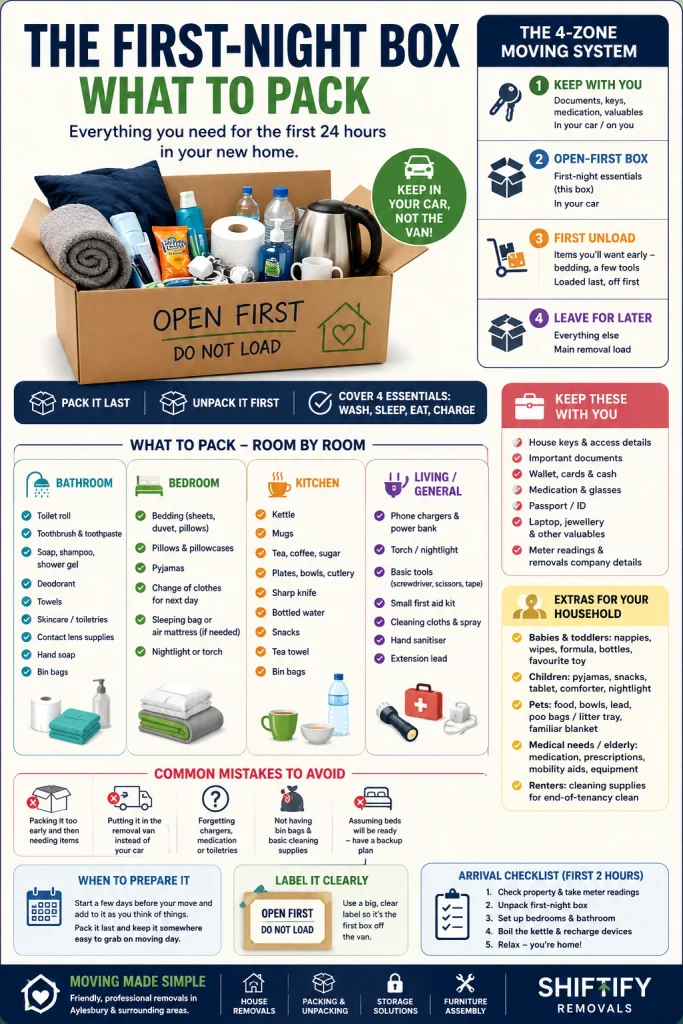
The four zone system
The easiest way to pack for moving day is to sort your belongings into four zones. It sounds obvious, but it is the single best trick for making sure the important things do not end up at the bottom of the van. Once you start thinking in zones, packing decisions become much quicker.
The first zone is the things you keep with you at all times. This is your documents, keys, medication, and anything valuable. These never go in the van under any circumstances. The second zone is your open first box, which holds the first night essentials this guide is all about. It rides in your car alongside zone one. The third zone is the items you will want early at the new home, such as beds, bedding, and a few basic tools. These go into the van last so they come off first. The fourth zone is everything else, which makes up the main removal load and can wait until you are ready.
Here is the same idea in a table.
| Zone | What it holds | Where it goes |
| 1. Keep with you | Documents, keys, medication, valuables | On you or in the car |
| 2. Open first | First night essentials | In the car |
| 3. First unload | Beds, bedding, essential tools | Loaded last, off first |
| 4. Later | Everything else | Main removal load |
When you are unsure where something belongs, ask yourself one question. Will I need this in the first 24 hours? If the answer is yes, it goes in zone one or two. If the answer is no, it can safely wait. That single question keeps the whole system simple.
The complete first night box checklist
This is your master list. Tick items off as you pack, and remember that not every item applies to every home, so use what fits your household. We have grouped it by area to make it easier to gather things room by room.
Start with your documents and valuables, and keep this group with you rather than in the van.
- House keys and access details
- ID or passports
- Completion or tenancy documents
- Insurance documents
- Removal company details
- Meter reading records
- Phone and laptop
- Wallet, cards, and cash
- Medication and glasses
For the bathroom, pack enough to wash and freshen up on the first evening and the next morning.
- Toilet paper
- Hand soap
- Toothbrushes and toothpaste
- Shampoo and shower gel
- Deodorant
- Towels
- Toilet cleaner
- Bin bags
For the bedroom, the aim is a made up bed so you can sleep properly after a hard day.
- Duvet and duvet covers
- Sheets and pillowcases
- Pillows
- Pyjamas
- Clothes for the next day
- Sleeping bags or an air mattress, if the beds will not be built in time
For the kitchen, you only need enough to make drinks and a simple meal.
- Kettle
- Mugs
- Tea, coffee, and sugar
- A small carton of milk
- Bottled water and snacks
- Plates, bowls, and cutlery
- A sharp knife
- Tea towel and bin bags
For electronics, think about staying powered up and being able to see once it gets dark.
- Phone chargers
- Power bank
- An extension lead
- Laptop charger
- Torch and spare batteries
- A nightlight
Finally, pack a few cleaning supplies, because new homes are not always left as clean as you would hope.
- Household cleaner
- Kitchen roll and cloths
- Sponges
- Disinfectant
- Bin bags
If you would like to take this list with you on moving day, we can turn it into a one page printable version you can tick off as you pack. Just ask and we will send it over.
What not to put in your first night box
It is surprisingly easy to let your first night box quietly grow into just another moving box. The whole point is to keep it small and focused, so be strict about what goes in. As a rule, leave out anything you will not touch in the first day or two.
That means no heavy books, no ornaments or decorative pieces, and no kitchen gadgets beyond the basics. Seasonal or spare clothing can wait, as can most of the children’s toys, apart from one or two comfort items that help little ones settle. Paperwork you will not need immediately belongs in the main load rather than here. Remember that the goal is never to unpack the whole house on day one. It is simply to make the first 24 hours comfortable, and a lighter box does that far better than a heavy one you can barely lift.
Extras for your household
The basics above are the same for almost everyone, but the finishing touches depend on who is moving. A little thought here makes the first night much easier for the people who feel a move the most.
If you are moving with a baby or toddler, pack nappies, wipes, formula or food, bottles, a familiar toy, and a spare change of clothes. Having these ready means you are not searching through boxes at bedtime with a tired child on your hip.
For older children, a favourite toy or comforter makes a strange new bedroom feel safe. Add pyjamas, a few snacks, a tablet with headphones, and a nightlight, and the first evening becomes an adventure rather than an upheaval.
Pets need their own small kit too. Pack food and bowls, water, a lead or carrier, poo bags or a litter tray, and a familiar blanket that smells of home. Introduce animals to the new house calmly, one room at a time, so they can settle at their own pace.
Finally, if anyone in the family has medical needs or you are moving an elderly relative, keep all regular medication, prescriptions, mobility aids, and any equipment easy to reach. These items should always travel in zone one, with you, never in the van.
First night box or overnight bag?
A neat way to organise everything is to split shared items from personal ones. Household things that everyone uses go in the box, while each person keeps their own overnight bag for personal bits. It keeps the box tidy and means nobody is rummaging through a shared container for their own toothbrush.
| First night box (shared) | Overnight bag (personal) |
| Kettle | Clothes |
| Tea and coffee | Toiletries |
| Plates and cutlery | Medication |
| Cleaning supplies | Phone charger |
| Bin bags | Pyjamas |
How big should your first night box be?
It does not need to be large at all. For most households, one medium box plus an overnight bag for each person is plenty. If you are moving with young children, pets, or specific medical needs, add one extra bag or box for their essentials and you will have everything covered. The most important thing is to keep it light enough to carry comfortably, because on moving day you will be lifting it in and out of the car yourself.
When to prepare it
Start putting your box together a few days before the move, adding things as you think of them. A sticky note on the lid where you jot down items as they come to mind works brilliantly. The actual daily essentials, like your toiletries, chargers, and the kettle, should go in on the night before or the morning of the move, since you will use them right up to the last minute. That way the box is genuinely the last thing loaded and the first thing off.
How to label and transport it
A clear plastic tub is ideal for a first night box, because you can see straight through it and it will not collapse if the weather turns wet on moving day. A sturdy cardboard box does the job just as well if that is what you have. Whatever you use, write “open first” and “do not load” on the top and on at least two sides, so it is obvious in a packed van and nobody moves it by mistake.
Above all, keep this box in your own car rather than the removal van. That single habit means you always have your essentials to hand, even if there is a delay getting the keys. Try not to overfill it either, since a box you can barely lift defeats the purpose. If you would like a hand with the rest of the packing, our packing and unpacking service takes care of the heavy work so you can focus on the essentials.
Your first two hours in the new home
Once you are through the door, a simple routine helps you settle quickly rather than standing in the hallway wondering where to start. In the first fifteen minutes, walk through the property room by room, take and photograph your meter readings, and find the stopcock, the fuse box, and the gas meter. Check that the water, electricity, and heating are all working, so you know early if anything needs sorting.
In the first hour, get the practical things going. Put bedding into the bedrooms, set up the bathroom with your toiletries and towels, and put the kettle on for the drink you have been waiting for all day. Get everyone’s phones on charge, and sort out the pet and child essentials so the whole household feels settled. Then, before bed, lock all the doors and windows, check the heating is on if you need it, put any rubbish somewhere accessible, and keep your keys and phones together in one obvious spot so you are not hunting for them in the morning.
Common mistakes people make
Even well organised movers slip up on the same handful of things. The most common is leaving the box until the last moment and then packing it in a rush, which is exactly how half the contents get forgotten. Another classic is loading the box into the van by accident, which is why clear labelling matters so much. People also forget a phone charger or power bank, run out of toilet roll and hand soap on the first evening, and underestimate how much of a lift a cup of tea gives everyone after a long day. Plan for children and pets in advance, because they feel a move more than anyone, and you will avoid the most stressful moments entirely.
Moving into Aylesbury? Plan for access
If you are moving within Aylesbury or to a nearby town such as Wendover, Thame, Buckingham, Oxford, or Milton Keynes, your move will often be a single day job. That means you will usually be unpacking your first night box the very same evening, which makes having it ready all the more important.
It is worth keeping the box in your car for a local reason too. Parking in and around the town centre can be tight, and some of the older residential streets are narrow, so the van sometimes arrives a little after you do or has to park a short walk from the door. On completion day there can also be a short gap between handing back the keys to your old home and getting access to the new one. Keeping your essentials with you smooths over all of those small timing issues. If you are planning the wider move as well, our house moving checklist lays out the weeks beforehand, and our moving on a budget guide shows where you can keep costs down.
The bottom line
A first night box is the simplest and cheapest way to take the stress out of moving day. Cover the four basics of washing, sleeping, eating, and charging, keep the box with you rather than in the van, and label it clearly so it stands out. Do that, and your first evening in the new home can be about resting and settling in, not searching. Everything else can happily wait until the morning.
If you still have all your packing ahead of you, Shiftify Removals offers professional packing and unpacking across Aylesbury and the surrounding area, so you can hand over the hard part and keep your energy for the move itself.
Why choose Shiftify Removals
We are an Aylesbury based, family run removals company (confirm) with more than 15,000 moves behind us (confirm). We help your move go smoothly from the very first box to the very last, and we treat every home as if it were our own.
Every move includes DBS checked crews and goods in transit and public liability cover (confirm all), with a clear price agreed up front so you always know what to expect. Alongside house moves, we also offer house removals, packing, furniture assembly, storage, and long distance moves.
If you have a move coming up, you can get a free, no obligation quote or call us on 07392 665519 . It takes about a minute, and you will get honest help from a team that knows Aylesbury well.
First night box FAQs
What should I pack in an essentials box when moving house?
Pack everything you will need in the first 24 hours. That covers toiletries, towels, toilet roll, bedding, pyjamas, a change of clothes, medication, a kettle, mugs, tea or coffee, snacks, water, chargers, a torch, basic tools, and cleaning supplies. Your keys, documents, and valuables should stay with you rather than in the box.
How big should a first night box be?
It does not need to be big. One medium box plus an overnight bag for each person is usually enough for most households. Add one extra bag if you are moving with children, pets, or medical needs, and keep the box light enough to carry easily.
Should I pack a first night box for each family member?
The tidiest approach is to share one household box for things like the kettle and cleaning supplies, then give each person their own overnight bag for clothes, toiletries, and medication. That way nobody is searching a shared box for their own things.
What should I pack for children on moving day?
Familiar comfort items make the biggest difference. Pack a favourite toy or comforter, pyjamas, some snacks, a nightlight, and a tablet with headphones so a new bedroom feels friendly rather than strange.
What should I pack for pets on moving day?
Bring food, bowls, water, a lead or carrier, poo bags or a litter tray, and a blanket or toy that smells of home. Introduce your pet to the new house calmly, one room at a time, so they can settle at their own pace.
Should my first night box go in the car or the removal van?
Always in your car. That way you keep hold of your essentials even if there is a delay getting the keys, and nothing important is stuck in the van when you need it.
What should I unpack first?
Make up the beds, set up the bathroom, and put the kettle on, then get phones charging and check your meter readings. Once those are done you have everything you need for the evening, and the rest can wait until the next day.