

An office move is one of the most disruptive things a business can do. It touches every department, every employee, every supplier, and every piece of equipment in the building. Most go wrong for one reason: the planning started too late.
Research on UK office moves suggests the average company relocates every
five to seven years, and in most cases the person coordinating the project
has little or no previous experience of managing a relocation.
Get a free fixed-price quote from our office removals service
we cover Aylesbury, Reading, Oxford, Maidenhead, London and across the South East]
What is the office move checklist timeline?
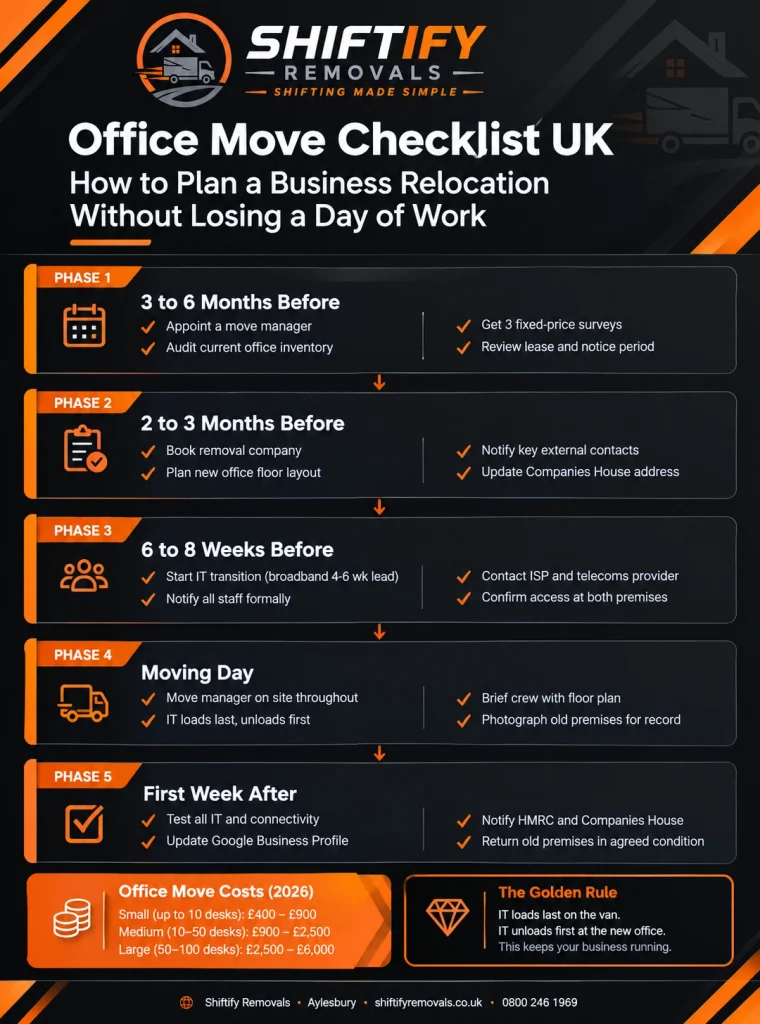
| When | What to do |
|---|---|
| 3 to 6 months before | Appoint a move manager, audit current office, brief removal companies |
| 2 to 3 months before | Book removal company, notify suppliers and key contacts, plan new floor layout |
| 6 to 8 weeks before | Notify staff, plan IT transition, arrange telecoms at new premises |
| 3 to 4 weeks before | Order packing materials, label system set up, parking and access confirmed |
| 1 to 2 weeks before | IT pre-move setup, data backups, final floor plan confirmed |
| Moving week | Pack non-essentials, confirm crew arrival time, brief staff on moving day roles |
| Moving day | Designated move manager on site, crew briefed, IT last off and first on |
| First week after | IT tested, post-move address updates, staff settled, debrief |
Who should manage your office move?
The first decision to make is who owns the project. An office relocation is not something that can be managed alongside a full-time role. It needs a dedicated move manager, either someone internal who is given capacity to focus on it, or an external project manager for larger moves.
The move manager is responsible for the timeline, the removal company relationship, internal communications, IT coordination, and the sign-off at both the old and new premises. If key staff are also moving house around the same time as the office move, our house removals service covers both. Without one person in this role, tasks fall between departments and things get missed.
For smaller offices of under 20 people, the office manager or a director usually takes this on. For anything above 50 people, a dedicated project lead is worth the investment in time. Businesses that spread responsibility across multiple people consistently experience longer downtime and more post-move problems.
What is the best way to plan an office move?
The best way to plan an office move is to start earlier than you think is necessary, appoint one person to own the project, audit what you have before you book anything, and plan the IT transition as a parallel workstream from the very beginning.
IT is consistently the cause of the most post-move downtime. Broadband and phone line lead times in commercial properties are often four to six weeks at a minimum. If the IT workstream starts at the same time as everything else, rather than in the final few weeks, most connectivity problems are avoidable.
The second most common cause of office move delays is the removal company discovering on the day that access, parking, or lift bookings have not been arranged. In towns like Reading, Oxford, and central Aylesbury, controlled parking zones mean a bay suspension or dispensation must be arranged with the council well in advance. We cover this as part of every office removal booking.
How far in advance should you plan an office move?
For a small office of up to 20 people: three months minimum. For a medium office of 20 to 100 people: four to six months. For a large office or a multi-site move: six to twelve months.
These timescales assume you are moving into an already fitted-out space. If the new premises need fit-out work, add the fit-out programme to the timeline before setting any removal date. If there is a gap between leaving the old premises and moving into the new one, our storage service can hold your office contents securely in between.
The most common mistake is booking a removal date before the commercial lease negotiation at the new premises is finalised. If the lease moves, the removal date moves, which affects IT installation dates, staff notice, supplier notifications, and everything else downstream. Lock in the lease, then set the move date.
3 to 6 months before the move
Appoint your move manager
As above. One person, with dedicated time.
Audit your current office
Walk through every department and make a full inventory of what is moving, what is being disposed of, and what needs specialist handling. Equipment that is owned versus leased matters here: leased equipment goes back to the supplier, not on the van.
Create three lists: moving to new premises, disposing of or recycling, returning to supplier. This audit also informs the removal company survey, so the more accurate it is, the more accurate the fixed price you receive.
Brief removal companies and get surveys done
Get at least three surveys from removal companies covering your area. A reputable commercial removal company will visit the premises, assess the volume, check access at both ends, and give you a fixed price in writing. A price given over the phone without a site visit is an estimate, not a fixed price.
Questions to ask at the survey stage (for a full checklist of what to ask, see our guide on how to choose a removal company):
- Do you use your own crew and own vehicles, or do you subcontract?
- What goods-in-transit insurance do you carry for commercial equipment?
- Can you move IT equipment including servers and network hardware?
- Do you offer an out-of-hours or weekend move to minimise business downtime?
- Do you handle parking bay suspensions and building access coordination?
- What is your policy if equipment is damaged?
At Shiftify, our office removals service includes commercial surveys and fixed written prices for office moves across Aylesbury, Reading, Oxford, Maidenhead, and the wider South East. We offer weekend and out-of-hours moves to keep disruption to a minimum.
Review your current and new lease
Check notice periods, dilapidations clauses, and reinstatement requirements at the current building. Understand what condition the premises need to be in when you hand back the keys. Budget for this separately from the removal cost.
2 to 3 months before the move
Book your removal company
Once you have three survey-based fixed quotes, compare them on scope, not just headline price. Check whether VAT is included, whether out-of-hours rates apply, and what the policy is on damage. For a full guide on comparing quotes fairly, see how much do removals cost in the UK. Then confirm your booking.
Book early. Weekend and out-of-hours slots for commercial moves fill up quickly, particularly at month-end and quarter-end when lease breaks cluster.
Plan the new office floor layout
Before a single piece of furniture moves, create a floor plan of the new space. Assign desks, meeting rooms, and storage areas. This is not just a nice-to-have: the removal crew needs to know exactly where every piece of furniture goes, and a clear floor plan cuts unloading time significantly.
Label furniture in the existing office with its destination in the new one. A colour coding system by department is the most efficient approach.
Notify key external contacts
Clients, suppliers, partner organisations, and regulatory bodies all need your new address. HMRC, Companies House, your bank, and your insurers are the most important. A change of address for a business is more complex than a domestic move: create a full list of every organisation that holds your business address and work through it systematically.
Companies House update: if your company’s registered address is changing, update it at Companies House promptly. Failure to update your registered address is a legal compliance issue.
6 to 8 weeks before the move
Start the IT transition planning
This is the most critical item in the entire timeline. Broadband and phone line installations at commercial premises in the UK typically require four to six weeks’ lead time from the provider. In some commercial buildings, particularly older stock in town centres across Aylesbury, Reading, and Oxford, the lead time can be longer.
Contact your internet service provider and telecoms provider as soon as possible. Confirm installation dates and test dates. If you are switching provider at the same time as moving, factor in that process separately.
Key IT tasks at this stage:
- Confirm broadband and phone line installation dates at new premises
- Identify which equipment is being moved and which is being replaced
- Plan server room or network cabinet setup at the new location
- Confirm who is responsible for IT move coordination: internal IT team or external managed service provider
- Begin data backup schedule ahead of move
- Plan for temporary connectivity if installation is delayed
Notify staff formally
All staff need clear, formal communication about the move: the date, the new address, any changes to working arrangements, and what is expected of them during the move itself.
Address practical questions before they arise. What is the parking situation at the new premises? Is there a canteen or nearby lunch option? What is the commute like from the areas where your staff live? For businesses moving across Buckinghamshire or Berkshire, changes to the commute from Aylesbury, Bicester, Winslow, or Princes Risborough can genuinely affect staff retention.
3 to 4 weeks before the move
Set up your labelling system
Every item that moves needs a label. The most effective system for office moves uses colour-coded labels by department, with a number that corresponds to a floor plan position at the new premises. The removal crew can then load items by zone, unload by zone, and place items in the correct position without instruction.
Boxes should be labelled on at least two sides, not just the top. When boxes are stacked, you cannot see the top.
Order packing materials
Double-walled cardboard boxes, packing tape, bubble wrap, packing paper, and document boxes. For sensitive equipment, anti-static packaging is needed. For hanging files, transfer boxes with hanging rails keep documents in order. Do not use single-walled boxes for anything heavy.
Confirm access and parking at both premises
For the old building: when can the removal van arrive? Are there lift size restrictions? Is there a loading bay? What time does the building manager require you to have vacated?
For the new building: same questions. In controlled parking zones including central Reading (RG1), central Oxford (OX1), and Maidenhead town centre, a bay suspension from the council is required for the removal van to park legally. We arrange this as part of our commercial booking process.
1 to 2 weeks before the move
IT pre-move tasks
- Complete all data backups
- Label every cable, port, and piece of equipment with its destination
- Photograph server rack, network cabinet, and workstation setups before anything is moved
- Confirm handover procedure with your IT provider or internal IT team
- Test connectivity at the new premises if installation has already taken place
Non-essential packing begins
Archives, reference materials, stationery stock, and equipment not needed for daily operations can all be packed and ready before moving week. The less that is left for moving day, the faster and cheaper the move.
Communicate the moving day plan to staff
Every employee needs to know:
- The exact date and time the office will be closed
- When they are expected to be at the new premises
- Whether they are needed on moving day or should work from home
- Who to contact with questions
Notify all staff formally with the move date, new address, and what is expected of them on moving day. Send clients and suppliers a separate notification at least one week before the move date. Both communications should include the new address, the effective date, and a contact name for questions. Keep them factual and brief.
Moving day: how to run it
The move manager is on site from start to finish
Moving day runs better when one person is in place at the old premises during loading and another is ready at the new premises during unloading. If there is only one person available, they move with the crew.
Brief the removal crew on arrival
Walk the crew through the building, show them the floor plan, explain any fragile or specialist equipment, and confirm the sequence: IT equipment loads last and comes off first at the other end. This is the single most important instruction on a commercial moving day.
IT loads last, unloads first
IT equipment is the reason the business can function the following morning. Loading it last means it is at the back of the van and comes off first at the new premises. The IT team or provider should be on site at the new location to take delivery of equipment directly and begin setup immediately.
Keep a problems log
Note anything that does not go to plan: items that were damaged, access issues that caused delays, equipment that did not match the inventory. This log is needed for any insurance claims and for the post-move debrief.
Moving day final checklist
Before the van leaves the old premises for the last time, check these areas. Office moves regularly leave things behind in areas that were out of sight during packing.
- Every office, meeting room, and breakout area checked and cleared
- Kitchen and staff room fully cleared including fridge, cupboards, and appliances
- Server room and comms room: only equipment confirmed for disposal should remain
- Stationery cupboards and storage rooms fully cleared
- Car park and external storage areas checked
- All keys, fobs, and access cards collected from staff and accounted for
- Meter readings taken at old premises (gas, electricity, water)
- Photographs taken of all rooms in current condition for dilapidations record
- Building manager signed off on access arrangements for the removal crew
- Problems log up to date with anything noted during the day
- Move manager has contact details for removal crew lead, IT contact at new premises, and building manager at both sites
Post-move checklist: first week at the new premises
Day 1:
- IT team tests all workstations, phones, printers, and networked equipment
- Confirm broadband speed and connectivity meet operational requirements
- Check all furniture and equipment has arrived and is in the correct position
- Log any damaged or missing items immediately with photographs
- Confirm keys have been returned to old premises building manager if applicable
Days 2 to 3:
- Update website address and contact page
- Update email signatures for all staff
- Update Google Business Profile (allow a few days for verification)
- Update LinkedIn company page
- Notify clients and suppliers of new address if not already done
Days 4 to 7:
- Update HMRC business address
- Update Companies House registered address if changing
- Update VAT registration address
- Update bank and insurers
- Update any industry directories or membership organisations
- Arrange final inspection at old premises with landlord or building manager
- Confirm dilapidations are resolved and get written sign-off
End of first week:
- Debrief the team: what went well, what did not, what would you do differently
- Complete any insurance claims for damaged items
- Confirm removal company has received any outstanding payment
Legal compliance checklist:
| Organisation | Action | Deadline |
|---|---|---|
| HMRC | Update business address | Within 30 days |
| Companies House | Update registered address | As soon as possible |
| HMRC VAT | Update VAT registration | Within 30 days |
| Business bank | Update address | First week |
| Insurers | Update business premises address | Before move date |
| ICO (data protection) | Update if registered | First week |
Failure to update Companies House within a reasonable time is a legal compliance issue. Update your registered address at Companies House as a priority in the first week.
How much does an office move cost in the UK?
Office removal costs vary significantly by business size, distance, and whether an out-of-hours move is needed. Based on 2026 UK market data:
| Office size | Local move | Regional move (50 to 150 miles) | Out-of-hours uplift |
|---|---|---|---|
| Small (up to 10 desks) | £400 to £900 | £700 to £1,400 | 15 to 25% |
| Medium (10 to 50 desks) | £900 to £2,500 | £1,500 to £4,000 | 15 to 25% |
| Large (50 to 100 desks) | £2,500 to £6,000 | £4,000 to £10,000 | 15 to 25% |
These figures cover the removal company cost only and include VAT at 20%. They do not include IT installation, fit-out work, dilapidations, or new furniture.
Full office move budget: what to include beyond the removal cost
| Budget item | Typical cost range | Notes |
|---|---|---|
| Removal company | £400 to £6,000+ | Based on office size, see table above |
| Parking bay suspensions | £25 to £150 per bay | Council fee, varies by location |
| IT installation and broadband | £200 to £2,000+ | Depends on complexity and provider |
| New furniture | Variable | If not all existing furniture is moving |
| Dilapidations and reinstatement | Variable | Check your lease carefully |
| Professional cleaning (old premises) | £150 to £600 | Often required by lease |
| Stationery and printed materials | £100 to £500 | New address on letterheads, cards |
| Staff communication and signage | £50 to £200 | New building signage and wayfinding |
| Contingency (10 to 15%) | Add to total | Delays, access issues, last-minute costs |
The removal company cost is typically 20 to 40% of the total office move budget. Budget for all categories before committing to a move date.
For South East locations including Aylesbury, Reading, Oxford, and Maidenhead, expect costs toward the higher end of each range due to regional pricing and parking suspension fees. For businesses relocating between cities or regions, see our long distance removals service for routes across the UK.
A free video survey produces a written fixed price based on your specific premises and requirements. Use our free removal cost calculator for a budget estimate, then book a survey for a binding price.
IT equipment: what the removal company can and cannot do
A commercial removal company moves the physical equipment. Disconnecting and reconnecting IT systems is a separate workstream that belongs to your IT team or managed service provider.
What the removal company does: Carefully packs workstations, monitors, and peripheral equipment in anti-static packaging. Moves server racks and network equipment with appropriate handling. Transports everything to the new premises and places it in the correct position according to the floor plan.
What the IT team or provider does: Disconnects equipment from the network before the move. Labels every cable and port. Reconnects and configures equipment at the new location. Tests all systems before staff arrive.
The clearest handover point is: the IT team prepares equipment for the removal crew, the removal crew moves it, the IT team takes delivery and reconnects.
IT vendor and provider checklist for an office move:
- Internet service provider: confirm installation date at new premises, minimum four to six weeks notice required
- Phone system provider (VoIP or traditional): confirm number porting or new line installation
- Cloud services (Microsoft 365, Google Workspace): no physical move needed but update billing address
- Managed service provider: brief them on the move timeline and confirm who owns each workstream
- CCTV and alarm system: arrange engineer visit at new premises for reinstallation
- Franking machine: notify Royal Mail of new address
- Any hardware leases or maintenance contracts: update address with each supplier
Remote working plan for moving day:
If staff cannot work from the new premises on the day after the move (due to IT delays or access), have a remote working plan in place. Confirm VPN access works, confirm cloud-based systems are accessible from home, and communicate this to staff before the move, not after.
The businesses that recover fastest from an office move are those that treated remote access as a contingency, not an afterthought.
What should you do with old office furniture when moving?
Not everything in your current office needs to move. An audit at the three to six month stage identifies what is worth moving and what is not.
Options for furniture you are not moving:
Donate: Charities, community organisations, and schools in the local area often accept good-condition office furniture. In the Aylesbury area, organisations including AVDC community groups and local charities accept donations. Contact them directly.
Sell: Facebook Marketplace, Gumtree, and specialist office furniture resellers. A desk and chair set in good condition can recover a meaningful amount toward the cost of new furniture.
Recycle: Most commercial furniture can be recycled through specialist contractors. The gov.uk waste disposal guidance covers business waste obligations.
Dispose via a commercial waste contractor: For large quantities, a commercial waste clearance contractor is the most efficient route.
Do not mix office furniture disposal with the removal booking. The removal company moves what you are keeping. Everything else should be dealt with separately before moving day.
Frequently asked questions
How do I plan an office move without losing productivity?
Appoint a move manager, start planning at least three months before, move outside of working hours (evenings or weekends) where possible, and ensure IT is reconnected and tested before staff arrive at the new premises. The businesses that lose the least productivity are those that treat IT as a parallel workstream from the start, not an afterthought in the final week.
How long does an office move take?
A small office of up to 10 desks typically takes one day including packing. A medium office of 10 to 50 desks typically takes one to two days. A large office of 50 or more desks may need two to three days. Out-of-hours moves spread the work across evenings and weekends to avoid any disruption to the working day.
What is the best time to move an office?
Weekend moves are the most common choice because they cause the least disruption to the working week. End of month and end of quarter are the busiest times for commercial removals, so book early. Bank holidays and the period between Christmas and New Year can also work well for businesses that are already closed.
Do I need to notify HMRC when I move to the office?
Yes. Notify HMRC of your new business address, update your Companies House registered address if it is changing, and update your VAT registration address if applicable. All three are separate processes. Gov.uk has guidance on each.
How do I move server equipment safely?
Server equipment should be shut down, backed up, disconnected by the IT team, packed in anti-static packaging by the removal crew, transported upright where possible, and reconnected by the IT team at the new premises. Servers should not travel in the boot of a car or in a standard van without appropriate padding. A commercial removal company with experience in IT equipment moves will have the right packaging.
Do removal companies move IT equipment?
Yes, the physical movement. They do not disconnect, configure, or reconnect systems. That is the responsibility of your IT team or managed service provider. The handover point is: IT team disconnects and prepares, removal crew moves, IT team reconnects and tests.
What happens if something is damaged during the office move?
Report damage to the removal company immediately and document it with photographs. A reputable company carries goods-in-transit and public liability insurance covering commercial equipment. Check the cover limits and claims process before you sign the booking contract.
How do I update my business address after moving to the office?
Update your website and email signatures on moving day. Update your Google Business Profile, LinkedIn company page, and any directory listings in the first week. Update HMRC, Companies House, your bank, and your insurers within the first two weeks. Inform clients and suppliers by email on or just after moving day.
How do you plan an office move for a hybrid working team?
Hybrid working changes the office move in two ways. First, the furniture and desk count may be lower than the total headcount if hot-desking is in place. Audit actual usage before finalising the floor plan at the new premises. Second, remote workers still need to be notified, still need updated address details, and still need to know their IT access will be unaffected during the move period. Include them in all communications and confirm that VPN and cloud systems are tested before moving day.
What insurance do you need for an office move?
Your removal company should carry goods-in-transit insurance and public liability insurance. Check the cover limits and whether IT equipment, servers, and high-value items are included or excluded. Your own business contents insurance may also apply during a move. Check with your insurer before the move date whether your policy covers items in transit, and whether you need to notify them of the move. Do not assume cover extends automatically.
Who is responsible for health and safety during an office move?
The move manager and the business are responsible for health and safety in the building during the move. This includes ensuring walkways are clear, heavy items are handled by trained crew only, and hazardous materials are properly disposed of before the move. The removal company is responsible for the safety of their own crew during loading and unloading. If you are moving in a managed commercial building, check the building manager’s requirements for move-day procedures.