
The honest answer is more than you think. Every person who has moved house has either run out of boxes at 11pm the night before, or ended up with a stack of empties they had to flatten and recycle. Getting the number right before you start saves both problems.
This guide gives you a realistic figure based on property size, a room-by-room breakdown, box size guidance, specialty boxes, where to get boxes free or cheap, the eco-friendly options, and a checklist for moving day. After 20,000 moves, these are the numbers and techniques our team see working in practice.
If you would rather not pack at all, our professional packing service covers everything from materials to placement at the new home.
[Get a free fixed-price quote including packing — takes 15 minutes by video call]
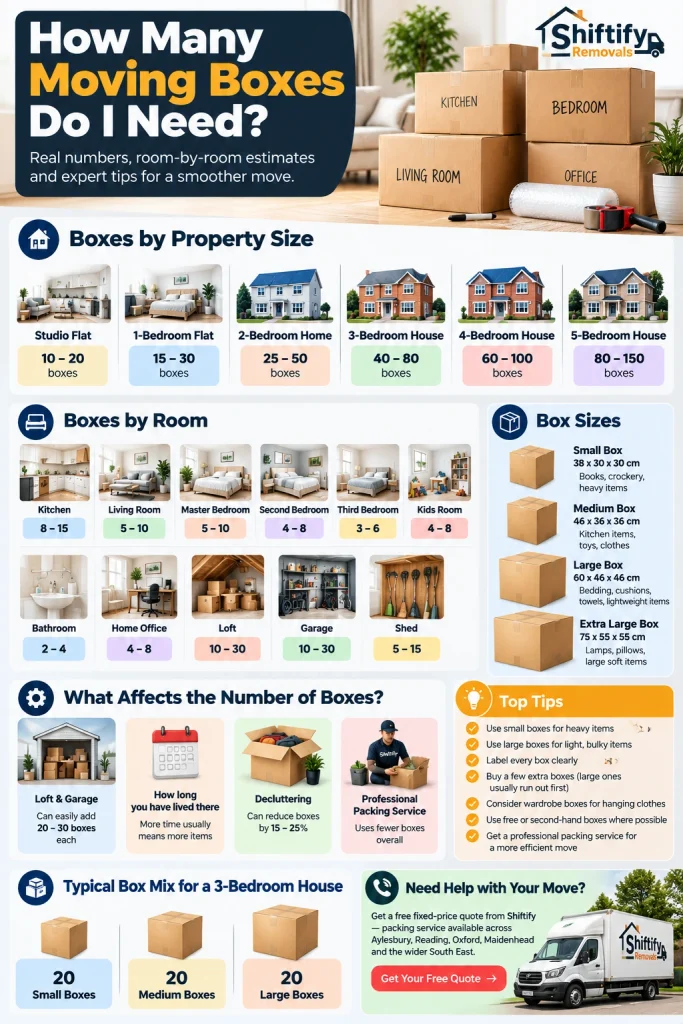
Quick answer: how many boxes do you need by property size?
| Property size | Minimum | Realistic average | Heavy packer or full loft and garage |
| Studio flat | 10 | 15 | 20 |
| 1-bedroom flat | 15 | 20 to 25 | 30 |
| 2-bedroom home | 25 | 35 to 40 | 50 |
| 3-bedroom house | 40 | 50 to 60 | 80 |
| 4-bedroom house | 60 | 70 to 80 | 100 |
| 5-bedroom house | 80 | 100 to 120 | 150 |
These figures assume a garage or loft at the higher end. A recently decluttered 3-bedroom house with a clear loft needs far fewer boxes than one not touched in five years.
Why does bedroom count not tell the whole story?
Bedroom count is a useful starting point, but two 3-bedroom houses can need completely different numbers of boxes.
A 3-bedroom house in Aylesbury with a double garage, a boarded loft, and a family that has lived there for 15 years might need 80 boxes. A 3-bedroom new-build in Maidenhead with minimal storage, no loft, and a couple who moved in two years ago might need 40.
The factors that change the number most are:
- The garage and loft (each can add 20 to 30 boxes on their own)
- How long you have lived there
- Whether you declutter before packing
- Whether you use a packing service (professionals pack more efficiently and use fewer boxes)
How to calculate how many boxes you need
Use this method for a more accurate estimate than bedroom count alone.
Step 1: Walk through each room and pick a number from the room-by-room table below.
Step 2: Add the numbers together.
Step 3: Add 15% as a buffer for items you will find in the back of cupboards.
Step 4: Round up to the nearest 5 or 10.
For example: a 3-bedroom house with a medium kitchen (10 boxes), a living room with books and ornaments (8 boxes), three bedrooms (6 plus 5 plus 4 boxes), a bathroom (3 boxes), a home office (5 boxes), a well-stocked loft (20 boxes), and a single garage (15 boxes) adds up to 76 boxes before the 15% buffer, which gives approximately 87. Round up to 90.
Use our free removal cost calculator to estimate the full cost of your move once you have your box count.
How many boxes per room?
| Room | Typical box count | What drives the number |
| Kitchen | 8 to 15 | Crockery, appliances, pantry items, glassware |
| Living room | 5 to 10 | Books, ornaments, electronics, board games |
| Master bedroom | 5 to 10 | Clothes, shoes, bedding, personal items |
| Second bedroom | 4 to 8 | Clothes, bedding, stored items |
| Third bedroom | 3 to 6 | Often doubles as storage |
| Kids room | 4 to 8 each | Toys, books, games, clothes |
| Bathroom | 2 to 4 | Toiletries, towels, cabinet contents |
| Home office | 4 to 8 | Files, books, equipment, cables |
| Loft | 10 to 30 | Seasonal items, suitcases, stored boxes |
| Garage | 10 to 30 | Tools, garden equipment, sports gear |
| Shed | 5 to 15 | Garden tools, outdoor items |
Use the lower end if the room is minimal. Use the higher end if it is well-stocked or doubles as storage.
What size boxes do you need?
Getting the size right matters as much as getting the number right.
| Box size | Approx dimensions | What goes in it | Weight limit |
| Small | 38 x 30 x 30 cm | Books, crockery, heavy kitchen items, tools, tins | Up to 20kg |
| Medium | 46 x 36 x 36 cm | Kitchen equipment, toys, appliances, clothes | Up to 15kg |
| Large | 60 x 46 x 46 cm | Bedding, cushions, duvets, towels, soft items | Up to 10kg |
| Extra large | 75 x 55 x 55 cm | Lamps, pillows, large lightweight items | Up to 8kg |
The rule that matters most: heavy items in small boxes, light items in large boxes.
A large box full of books is impossible to carry safely and often splits at the bottom. A small box of bedding wastes space and adds boxes. The most common self-packing mistake across all the moves our team does is large boxes packed with heavy items.
Suggested mix for a 3-bedroom house:
- Small boxes: 20 (books, crockery, heavy kitchen)
- Medium boxes: 20 (general kitchen, office, bathroom, toys)
- Large boxes: 20 (bedding, clothing, cushions, towels)
- Extra large: 5 (pillows, lamps, lightweight bulky items)
What specialty boxes do you need?
Standard cardboard boxes do not suit every item. Here are the specialty options worth knowing about.
Wardrobe boxes: These have a built-in hanging rail and let clothes travel still on their hangers. A standard wardrobe box holds around 50 to 60 items of hanging clothing. Most households need two to four. Count your hanging rails and divide by 50. If budget is a concern, vacuum bags for folded items reduce the need for wardrobe boxes.
Dish pack boxes: Double-walled boxes designed specifically for crockery and glassware, often with built-in cell dividers. They significantly reduce breakage risk on kitchen items. Worth buying if you have a lot of china or glassware.
Picture and mirror boxes: Flat, shallow boxes with adjustable sizing designed for framed artwork and mirrors. A standard box wrapped in blankets works for smaller items, but a purpose-made picture box is better for large or valuable framed pieces.
TV boxes: Purpose-sized boxes for flat-screen TVs. Use the original box if you kept it. If not, purpose-made TV boxes are available in a range of sizes from removal companies and moving supply retailers.
Mattress bags: Not boxes, but essential. Protect mattresses from dirt, moisture, and scuffs in transit. Cheap and worth using for every mattress.
How does decluttering change the number?
Significantly. Decluttering before buying boxes gives you a more accurate estimate and reduces the cost of your move directly, because less volume means a smaller van or fewer trips.
A systematic declutter typically reduces box count by 15 to 25% for a house that has not been cleared in several years. For a property where accumulation has been high, a family home of ten or more years with a full loft and garage, the reduction can be 30% or more.
The most practical approach is to walk each room before buying boxes and decide what is coming and what is not. Charity shops, Freecycle, Facebook Marketplace, and a skip are your options. The removal company moves what is on the van. The less that is on it, the lower the cost.
How many boxes if you use a professional packing service?
If you book a full packing service, the number of boxes is determined by the crew. Professional packers use fewer boxes overall because they pack more efficiently, fill boxes to the correct weight, and use the right size for each category.
A professionally packed 3-bedroom house typically uses 40 to 55 boxes compared to 50 to 70 for a self-packed equivalent.
With a professional packing service, you do not buy boxes at all. The crew brings everything: boxes in all sizes, packing paper, bubble wrap, tape, mattress bags, and wardrobe boxes. This is included in the packing service cost.
How much do moving boxes cost?
| Source | Cost per box | Quality | Best for |
| Removal company | £1.50 to £3.00 | Double-walled, purpose-made | All items |
| Online moving supplies | £1.00 to £2.50 | Double-walled | All items |
| DIY/hardware stores | £1.00 to £2.00 | Varies | General use |
| Supermarkets (free) | Free | Single-walled | Light, non-fragile items |
| Facebook/Nextdoor (free) | Free | Varies | Budget moves |
| Buy-back scheme | Refundable deposit | Double-walled | Reduces net cost |
For a 3-bedroom house needing 60 boxes at an average of £1.50 each, budget around £90 for boxes alone. Add packing paper, bubble wrap, and tape, and a realistic materials budget is £120 to £180.
Some removal companies, including Shiftify, offer a box supply service as part of the booking. Ask when you get your quote.
Eco-friendly moving box options
Standard cardboard boxes are recyclable and can be reused several times before they degrade. But there are greener options worth considering if sustainability matters to you.
Plastic crate hire: Rental companies provide solid plastic moving crates, which are reused hundreds of times, do not require tape, and are significantly stronger than cardboard. You hire them for the duration of your move, pack them, and they are collected after. The environmental cost per move is lower than single-use cardboard at scale.
Recycled cardboard boxes: Many moving supply companies now offer boxes made from recycled board. The strength is comparable to new cardboard for most applications.
Reuse and return schemes: Some removal companies and moving supply retailers offer box buy-back, where unused boxes are returned after the move. Shiftify can advise on local return options when you book.
Free second-hand boxes: Collecting boxes from supermarkets, off-licences, and local community groups gives used boxes a second life before recycling.
Repurposing household items: Suitcases, laundry baskets, large bags, and storage tubs all reduce the number of cardboard boxes needed. Use what you already have for items that pack safely in them.
Where do you get moving boxes?
Buy new from a removal company or moving supplies retailer. Purpose-made double-walled cardboard is significantly stronger than single-walled. Worth the cost for heavy items, crockery, and anything stacked.
Free from supermarkets. Most large supermarkets have boxes available. In the Aylesbury area, larger stores in the town centre and along the Oxford Road tend to have boxes during quieter trading hours. Ask staff directly rather than checking recycling areas.
Free from local community groups. Facebook Marketplace, Freecycle, and Nextdoor are reliable sources for boxes from recent movers in your area. Search your postcode area.
Avoid banana boxes and produce crates for anything heavy. They are single-walled and not designed to take stacking weight. Fine for towels and light items, not for books or kitchen contents.
How to label boxes properly
Labelling is as important as the box count. Poorly labelled boxes make unloading slower and unpacking harder.
Label every box on at least two sides, not just the top. Boxes stack. You cannot see the top once they do.
Every label should include:
- The destination room at the new home, not the room items came from
- A brief contents summary: “Kitchen: plates and bowls” is more useful than “Kitchen”
- “Fragile” on all four sides for breakable items
- A number if you are keeping a packing inventory
Colour coding by room makes unloading significantly faster. One colour of tape per room means the removal crew can put boxes in the right room without reading every label.
Moving day box checklist
Before the van leaves, check these areas. People forget rooms more often than they forget to pack items.
- Loft checked and cleared
- Garage checked and cleared
- Shed checked and cleared
- Every wardrobe and cupboard opened
- Under every bed checked
- Airing cupboard checked
- Garden furniture and equipment loaded or left by arrangement
- Fridge and freezer empty and dry
- All boxes labelled on two sides
- Fragile boxes clearly marked
- Essentials box loaded into your car, not the van
- Important documents with you personally
Frequently asked questions
How many boxes do I need for a 3-bedroom house?
A realistic average is 50 to 60 boxes. A property with a full loft and garage and not decluttered recently is more likely 70 to 80. A recently cleared 3-bedroom house with no loft might need only 40.
How many boxes do I need for a 2-bedroom flat?
Around 35 to 40 on average. Minimal storage and few ornaments might need only 25. A well-stocked kitchen and wardrobe over several years could need 50.
How many boxes do I need for a 1-bedroom flat?
Between 20 and 25 on average. A studio might need only 15. A 1-bedroom flat with lots of books and a well-stocked kitchen could need 30.
How many small, medium, and large boxes do I need?
For a 3-bedroom house: roughly 20 small, 20 medium, and 20 large as a starting point. Adjust based on your specific rooms. Large boxes tend to run out first, so buy a few extra.
Is it better to have too many or too few boxes?
Too many. Running out of boxes the night before a move is one of the most stressful moving day problems. Unused boxes can be flattened, returned, or listed for free online.
Are banana boxes from supermarkets good for moving?
Fine for light, non-fragile items. Not suitable for books, crockery, or anything stacked under other boxes. Use purpose-made double-walled boxes for heavy or breakable items.
How many wardrobe boxes do I need?
Count your hanging rails and divide by 50 (the approximate capacity of a standard wardrobe box). Most households need two to four.
How do I get free moving boxes near me?
Supermarkets, Facebook Marketplace, Freecycle, and Nextdoor are the most reliable sources. Ask supermarket staff directly. In the Aylesbury area, larger stores in the town centre tend to have boxes available during quieter trading hours.
Do removal companies provide boxes?
If you book a full packing service, yes. The crew brings all materials. If you are self-packing, you source your own boxes, though some companies including Shiftify can supply boxes as part of the booking.
What is the most eco-friendly way to get moving boxes?
Plastic crate hire has the lowest environmental cost per move at scale. Free second-hand boxes from community groups is the most accessible eco option. Repurposing suitcases, laundry baskets, and storage tubs reduces the total number of cardboard boxes needed.