

Most of what you own can go on a removal van without a second thought. But there are specific categories of items that removal companies will not move, and knowing what they are before moving day prevents last-minute problems, avoids damage to your belongings, and keeps the crew safe.
Get a free fixed-price quote from Shiftify Removals — we will tell you exactly what we can and cannot move at the survey stage
what removal companies will not move
| Category | Common examples | Why refused | What to do |
|---|---|---|---|
| Flammable liquids | Petrol, lighter fluid, paint thinner | Fire and explosion risk | Use up, dispose at tip |
| Compressed gas | BBQ canisters, camping gas, CO2 | Pressure risk in heat | Use up, dispose at tip |
| Paints and solvents | Gloss paint, white spirit, varnish | Flammable and corrosive | Use up, give away, tip |
| Fireworks and explosives | Fireworks, flares, detonators | Legal prohibition | Council hazardous waste |
| Firearms and weapons | Guns, ammunition, crossbows | Legal prohibition | Licensed transport by owner |
| Corrosive batteries | Car batteries, acid containers | Corrosive and hazardous | Scrapyard or tip |
| Perishable food | Frozen food, open containers | Spoilage and contamination | Use up, donate |
| Live plants | Garden pots, houseplants | Soil spillage, pests | Your own car |
| Pets | All animals | Safety and welfare | Separate transport |
| Cash and jewellery | Notes, coins, watches, rings | Insurance limitation | Keep personally |
| Important documents | Passports, contracts, deeds | Loss and security risk | Keep personally |
| Damaged lithium batteries | E-bike or e-scooter batteries | Fire risk | Declare at survey |
Why do removal companies have exclusion lists?
The restrictions exist for three distinct reasons. Understanding which reason applies to each item helps you take the right action.
Legal prohibition. Some materials cannot legally travel on a public road in an ordinary removal vehicle without specialist haulage licensing. Compressed gas cylinders, certain fuels, and firearms fall into this bracket under UK road transport regulations. The GOV.UK guidance on dangerous goods transport sets out the legal framework for what requires specialist handling.
Safety risk. Some items are not legally prohibited but create a genuine risk inside a loaded van, particularly during a long journey or in warm weather. Petrol vapour in a sealed van is a fire hazard. Pressurised aerosols can fail if the van gets hot. Corrosive battery acid can damage everything around it.
Insurance exclusion. Goods-in-transit insurance policies exclude certain categories. Even if a company were willing to take something, damage to an excluded item would not be covered. Valuables, cash, and jewellery fall here: recommending you keep them personally is about the limits of what insurance can protect, not distrust.
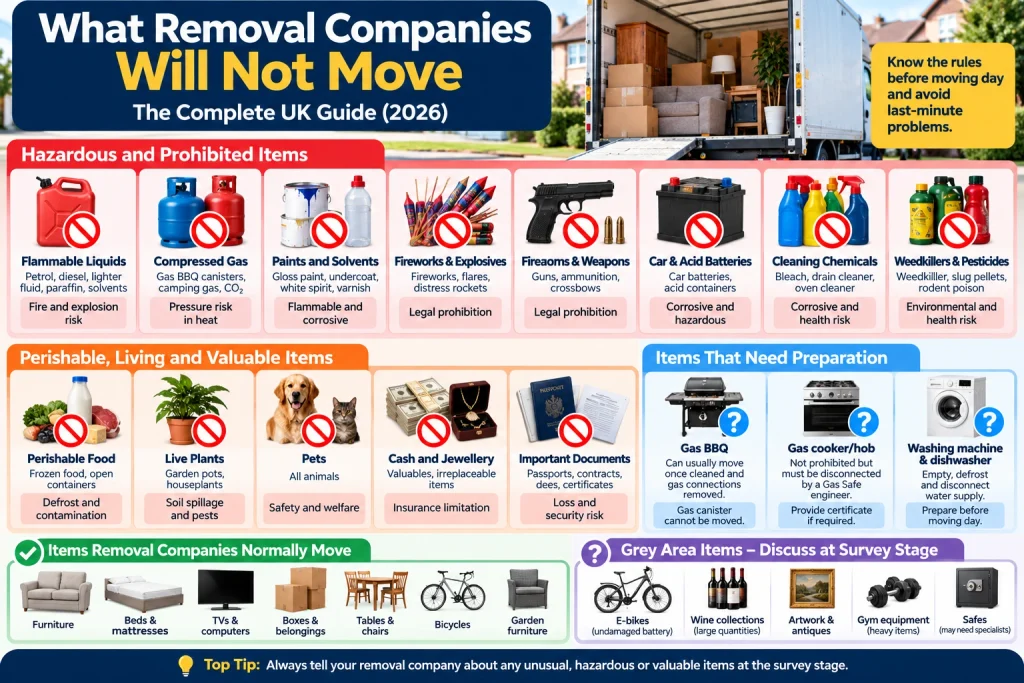
Hazardous and flammable items
These are the core exclusions across every UK removal company.
Fuels: Petrol, diesel, paraffin, kerosene, and lighter fluid. Even containers that appear empty retain vapour and residue. An empty petrol can is still refused. Use up or safely dispose of fuel before moving day. Your local household waste recycling centre accepts small quantities.
Compressed gas: Gas BBQ canisters, camping gas, patio heater bottles, and CO2 cylinders. Pressure increases in warm conditions and can cause a cylinder to rupture or vent inside the van. Use these up before your move or take them to your local tip.
Paints and solvents: Gloss paint, undercoat, wood stain, varnish, paint stripper, white spirit, turpentine, and nail varnish remover. Water-based emulsion paint in sealed tins is lower risk and some companies will take it. Check at the survey stage. Do not assume.
Fireworks and explosives: All fireworks, distress flares, detonators, and similar items are legally prohibited in transit in an ordinary removal vehicle. Dispose of unused fireworks via your local council hazardous waste collection.
Cleaning chemicals: Bleach, drain cleaner, oven cleaner, and corrosive products. These can leak and cause damage to other items, and fumes in a sealed van are a health risk. Use them up, give to a neighbour, or recycle.
Weedkillers and pesticides: Garden chemicals including weedkiller, slug pellets, rodent poison, and insecticides. Dispose via your local household waste recycling centre.
Car batteries and acid: Old car batteries contain sulphuric acid. Take to a scrap dealer or your local tip, which usually accepts them for free.
Aerosols: Small personal aerosols (deodorant, hairspray) in your bathroom box are generally fine. Large quantities or specialist aerosols (spray paint, industrial products) are not.
Firearms, weapons, and ammunition
Firearms and ammunition must be transported by the licensed owner under UK firearms law. They cannot go on a removal van under any circumstances. This includes shotguns, rifles, handguns, and any ammunition.
Knives classified as weapons under UK law are also excluded. Standard kitchen knives travel normally when wrapped safely.
If you hold firearms legally and need to transport them during a move, contact your local police firearms licensing department for guidance on the legal requirements.
Perishable food and the freezer
Perishable food does not travel safely in an unrefrigerated removal van. A long journey leads to thawed frozen food, spoiled dairy, and liquid spills that damage items around them.
What to do: Start using up your freezer and fridge contents four to six weeks before moving day. Donate non-perishable pantry items to a food bank if you have excess.
Defrost the freezer 24 hours before. The freezer must be completely empty and dry before it goes on the van. A freezer still defrosting in transit causes moisture damage to the floor and surrounding items. Dry the inside thoroughly after defrosting.
The fridge needs to be empty and switched off the night before. A fridge with food residue and moisture inside is unpleasant for the crew and can cause odours in transit.
Live plants
Most removal companies will move a small number of carefully packed houseplants as a courtesy, but they are not covered by goods-in-transit insurance. Large outdoor plants in heavy pots, trees, and shrubs are generally refused.
The main issues are soil spillage, root damage from being tipped, and the risk of pest transfer. Soil from a garden can carry pests into a new property.
What to do: Transport plants in your own car, upright and covered with a damp cloth. Do not leave them in a hot car for long periods.
Pets
Pets travel with you, not on the van. This is consistent across every removal company.
What to do: Plan pet transport before moving day. If pets are stressed by travel, speak to your vet about whether calming support is appropriate. Keep familiar bedding, food, and water accessible in your car. Consider whether a friend or family member can care for pets on moving day while loading and unloading happens, which is often less distressing for the animal.
Moving with fish: Aquarium fish need specific planning. The tank itself travels empty and dry on the van. Fish travel in sealed bags or containers with you or with a specialist. Speak to your local aquatics shop about the best method for your specific fish.
Cash, jewellery, and valuables
Goods-in-transit insurance policies have limits and exclusions on high-value items. Cash is almost universally excluded. Jewellery, watches, and collectable items are either excluded or covered only up to a low limit.
This is about the practical limits of insurance in transit, not distrust.
What to do: Cash, jewellery, and irreplaceable items travel with you personally in a bag you carry yourself. Never pack them into a box that goes on the van. For specialist items of significant value, speak to your home insurer about whether your policy covers transit, or arrange specialist art and antiques insurance for the move period.
Important documents
Passports, birth certificates, marriage certificates, property contracts, mortgage documents, solicitor correspondence, and medical records should never go on the removal van. Some are difficult or expensive to replace. Some create security risks if lost.
What to do: Keep all important documents in a single folder that you carry personally throughout moving day. This is one of the first things to put together and one of the last things that should go near a box.
E-bikes, e-scooters, and lithium batteries
This is a growing issue that most removal guides do not address. The London Fire Brigade and other UK fire services have issued guidance on the fire risks associated with lithium-ion batteries, including those in e-bikes and e-scooters.
Lithium-ion batteries carry a fire risk if they are damaged, over-discharged, or have a manufacturing defect. Battery fires burn extremely hot, spread fast, and are very difficult to extinguish in a confined space like a van.
Most removal companies will carry e-bikes and e-scooters with fully intact, undamaged batteries, but many now require disclosure at the survey stage. If the battery is damaged, shows signs of swelling, has been in a collision, or has not been charged in a long time, many companies will refuse it.
What to do: Declare e-bikes, e-scooters, and power tools with large lithium batteries at the survey stage. If a battery is suspect, arrange separate transport or speak to the manufacturer about safe disposal.
Medical equipment and mobility aids
Medical equipment such as oxygen concentrators, home dialysis equipment, stairlifts, and motorised wheelchairs can usually be moved, but they need to be discussed at the survey stage.
Home oxygen cylinders are compressed gas and cannot go on the van. Coordinate with your oxygen supplier for delivery of replacement cylinders to your new address before moving day.
Motorised wheelchairs and mobility scooters with lithium batteries need the same disclosure as e-bikes. Batteries that are damaged or suspect should be flagged.
Stairlifts are fixed to the property and require a stairlift engineer to remove and reinstall. This is separate from the removal process. Plan this well in advance.
What to do: Declare all medical equipment at the survey stage and speak to your equipment supplier and GP about any transition arrangements needed for your move.
Seasonal and garden items
Garden chemicals, weedkillers, pesticides, fertilisers, and fuels for garden equipment all fall into the hazardous category and cannot go on the van. Deal with these early: do not leave them to moving week.
Empty and clean the following before moving day:
- Lawnmower fuel tank (petrol)
- Strimmer and hedge trimmer fuel tanks
- Generator fuel tank
- Chainsaw fuel tank and oil reservoir
- Pressure washer (drain water to prevent freezing damage)
Garden equipment itself travels without issue once fuel has been removed. Garden furniture is straightforward. Heavy stone or ceramic pots need to be assessed for weight and access at the survey stage.
Gas appliances: a separate consideration
Gas cookers and gas hobs are not prohibited items, but they must be disconnected from the gas supply by a Gas Safe registered engineer before moving. This is a legal and safety requirement under Gas Safety (Installation and Use) Regulations 1998. The same applies for reconnection at the new property.
Book a Gas Safe registered engineer well in advance. In the Aylesbury, Reading, and Oxford areas, registered engineers typically need at least one week’s notice. Find registered engineers at gassaferegister.co.uk.
Restricted items in storage
Everything in the hazardous and flammable categories also applies to removal storage. If your belongings go into short-term storage during a chain delay or a delayed completion, the same exclusions apply. Petrol, compressed gas, paint, and similar items cannot go into storage units any more than they can go on the van.
If you are not sure whether something can go into storage, ask when you book. We will confirm what can and cannot be stored at the same time as we confirm the move.
Items that need advance discussion, not refusal
Not everything unusual is automatically refused. These fall into a grey area that needs a conversation at the survey stage.
Alcohol: A bottle of wine in your kitchen box is fine. A large collection of wine or spirits in glass bottles needs careful packing and disclosure for insurance purposes.
Legally held firearms: Cannot go on the van, but can be transported legally by the licensed owner. The removal company can help plan the overall move around this.
Large gym equipment: Treadmills, weight machines, and cable systems can usually be moved but may need specialist disassembly. Raise at the survey stage.
Antiques and high-value art: Not prohibited but fall outside standard goods-in-transit limits. Specialist packaging and separate specialist insurance are the right answer. Always raise at the survey.
Medical oxygen: Home oxygen cylinders are compressed gas and need a specific plan. Your oxygen supplier delivers to your new address. Coordinate in advance.
E-bikes and power tools with lithium batteries: As above, usually fine if the battery is undamaged. Declare at the survey stage.
Large aquariums: The tank and equipment travel empty and dry. Fish travel with you. Discuss the logistics at the survey for larger setups.
Cost implications of restricted items
Restricted items can affect the cost of your move in ways people do not always anticipate.
If you have significant quantities of garden chemicals, paint, or fuel to dispose of, your local council hazardous waste facility may charge a small fee. The gov.uk waste disposal guidance covers what applies in your area.
If gas appliances need disconnecting by a Gas Safe engineer, budget £50 to £150 for the visit depending on the work involved and your area.
If specialist insurance is needed for high-value antiques or art during transit, speak to your home insurer or a specialist broker. This is separate from the removal company’s goods-in-transit policy.
If an e-bike or power tool battery needs specialist disposal, your local tip will usually accept lithium batteries in the electrical recycling section. Some manufacturers also have take-back schemes.
International moves and restricted items
For international moves from the South East, including those starting in Aylesbury, Reading, Oxford, or along the London corridor, the restrictions are similar to domestic moves but may be stricter depending on the destination country.
Most countries prohibit the import of plants in soil (pest and disease risk), certain food products, and firearms without the correct import permits. Some countries have additional restrictions on lithium batteries in freight.
If you are planning an international removal, ask the removal company at the survey stage what additional documentation or restrictions apply to your destination. For moves to EU countries, there are specific rules on personal effects import that changed post-Brexit. GOV.UK has current guidance on taking goods out of the UK.
What happens if restricted items are on the van?
If restricted items are placed on the van without disclosure, there are several possible outcomes.
If the crew discovers them during loading, they will ask you to remove them. Moving day is not the time to deal with this. It causes delays and stress at the worst possible moment.
If they cause damage in transit (a petrol can leaks, a compressed gas cylinder vents), the goods-in-transit insurance claim for any resulting damage is likely to be refused. The cost of cleaning or repairing the van can be passed to you.
In serious cases involving genuinely hazardous materials placed on the van without disclosure, there may be legal liability beyond the insurance claim.
The straightforward advice: if you are unsure about anything, tell the surveyor at the survey stage. Most items that fall into a grey area have a simple solution that takes a few minutes to arrange. A problem discovered on moving morning does not.
What to do before moving day: action plan
Six weeks before:
- Start using up freezer and fridge contents
- Use up or dispose of garden chemicals, weedkillers, and pesticides
- Drain fuel from garden equipment
Two to three weeks before:
- Book Gas Safe engineer for gas appliance disconnection
- Arrange oxygen cylinder delivery to new address if needed
- Disclose e-bikes, e-scooters, and specialist items at the survey
One week before:
- Dispose of remaining paint tins (gloss and solvent-based)
- Take car batteries to scrapyard or tip
- Take compressed gas canisters to tip
- Use up or give away cleaning chemicals
Day before:
- Defrost freezer (leave 24 hours minimum)
- Empty fridge and leave open to air
- Gather important documents into a single folder
Moving day morning:
- Check every cupboard, garage, and shed for overlooked items
- Cash, jewellery, and valuables in a bag you carry personally
- Documents folder with you personally
- Essentials box in your car, not on the van
Frequently asked questions
What items will a removal company refuse to move?
The main categories are flammable liquids (petrol, lighter fluid), compressed gas (BBQ canisters, camping gas), paints and solvents, fireworks and explosives, firearms, perishable food, live plants, and pets. Cash, jewellery, and important documents should travel with you personally rather than on the van.
Can removal companies move paint?
Water-based emulsion paint in sealed tins is lower risk and some companies will take it. Gloss paint, undercoat, paint stripper, and solvent-based products are generally refused as hazardous. Check at the survey stage.
Can removal companies move gas bottles?
No. Gas BBQ canisters, camping gas, patio heater bottles, and all compressed gas containers are refused. Use them up or take them to your local household waste recycling centre before moving day.
Can removal companies move a gas BBQ?
The BBQ itself can travel once thoroughly cleaned and with all gas connections removed. The gas canister cannot. Dispose of the canister before moving day.
Can removal companies move an e-bike?
Usually yes, provided the battery is intact and undamaged. Declare e-bikes and e-scooters at the survey stage. Damaged or suspect batteries will be refused.
Will removal companies move frozen food?
No. Perishable and frozen food is not suitable for an unrefrigerated van. Start using up your freezer contents four to six weeks before the move.
Can removal companies move plants?
Some will move a small number of carefully packed houseplants as a courtesy. Large outdoor plants and heavy pots are generally refused. Transport plants in your own car.
Can removal companies move alcohol?
Normal quantities are fine. Large collections should be disclosed at the survey stage for insurance purposes and careful packing.
What should I keep with me on moving day?
Cash, jewellery, passports, birth certificates, property and mortgage documents, medication, keys, phone chargers, and any irreplaceable items. These travel with you in a bag you carry personally, not on the van.
What happens if I accidentally put a restricted item on the van?
The crew will ask you to remove it if discovered during loading. If it causes damage in transit, the insurance claim for resulting damage will likely be refused. Disclose anything you are unsure about at the survey stage.
Do the same restrictions apply to removal storage?
Yes. All hazardous and flammable items are also excluded from removal storage. Ask when you book if you are unsure about a specific item.
Are restricted items different for international moves?
Broadly similar but can be stricter depending on the destination country. Ask the removal company at the survey stage about destination-specific rules. GOV.UK has current guidance on taking goods out of the UK.